Tired of Sendbird's steep price hikes? Switch to our Free Sendbird Alternative (10K MAU) — featuring free end-to-end data migration and full Pro capabilities at $0.
Sendbird did something important: it made in-app chat accessible at a time when the alternative was building the entire stack from scratch. For a lot of teams, that mattered. For a lot of teams, it still does.
The frustration that's driving migrations in 2026 isn't that Sendbird doesn't work. It's that the cost of working with it — the pricing structure, the engineering overhead of building missing social-layer features — has started to outweigh what it delivers. Especially for teams whose products have grown past the use cases Sendbird was optimized for.
Why Teams Are Looking for Sendbird Alternatives
Sendbird is a mature platform. The Chat API is well-documented, the UIKit is polished, and for teams building standard in-app messaging on a tight timeline, it delivers. The complaints that drive teams away aren't usually about what Sendbird does — they're about the gap between what it costs and what it's built to do.
The pricing model penalizes growth at the wrong moments
Sendbird's plans are capped by Peak Concurrent Connections. A viral event — the kind of growth teams are actively trying to create — can trigger overage charges as high as $5.00 per additional connection depending on your MAU tier. The entry point sits at $399/month. Features that most teams would consider baseline — advanced moderation, large group support — are gated behind Enterprise plans, which means paying for a MAU tier you don't need just to unlock a specific capability.
The social layer isn‘t included by default
Sendbird's product roadmap has historically prioritized business-to-customer use cases like support and marketing workflows. This isn't a technical limitation — their APIs can support social features — but it means the social-layer primitives (friend management, group ownership, follow alerts, targeted messaging) aren't part of the out-of-the-box product. Teams building social apps or communities need to develop that logic themselves. For teams where the social layer is core to retention, that's a meaningful engineering investment to account for.
Friend management, group ownership transfer, per-member follow alerts, targeted group messaging, broadcast infrastructure — none of this ships with Sendbird. Teams building social apps, gaming communities, or marketplace products are writing that logic on their own backend servers. The engineering cost is real and it compounds as the product grows.
The Community Channel architecture has a similar gap. Sendbird's Open Channel handles high-volume live scenarios. For products that need structured community governance — sub-channels, role-based permissions, persistent history, user groups — the equivalent needs to be built or assembled from third-party tooling.
The Real Alternatives in 2026
Nexconn
Sendbird was built as a customer engagement platform — businesses communicating with users, support workflows, notification campaigns, AI customer service. The product architecture reflects that priority clearly and the execution is strong in those areas.
Nexconn was built as a communication foundation for products where the interaction happens between users — social apps, gaming communities, live streaming platforms, marketplaces, dating products, and any product where the social layer is what retains users rather than the content or the service.
A complete product architecture
Nexconn covers the same foundational building blocks — Direct & Group Channels for private high-trust interaction, Open Channels for high-velocity ephemeral scenarios, and Community Channels for structured persistent ecosystems. What differs is the depth at each layer.
Includes 20+ pages of infrastructure insights and growth strategies.
Community Channels in Nexconn means public and private sub-channels, role-based member permissions, channel-level message history, user group controls, and the governance granularity that large communities — gaming guilds, enterprise organizations, DAO structures — actually need to function. Sendbird's Open Channel handles concurrent volume. It wasn't designed for persistent structured community management at this level of specificity.
Group channels support 3,000 members natively versus Sendbird's basic 100-member cap. For products where community scale is a core feature, that difference shows up before you reach Enterprise pricing territory.
The social layer is native, not custom-built
Most of what competing platforms require separate backend engineering to implement ships with Nexconn by default. A complete friend management system — add, delete, block, request flows. Per-member follow alerts within groups. Full group ownership transfer without disrupting channel structure.
For apps where user relationships are the retention mechanism, this isn't a convenience — it's months of engineering work that either gets built or gets bought. Nexconn includes it.
Infrastructure built for where your users are
Nexconn's SD-CAN (Software Defined - Communication Accelerate Network) network spans 3,000+ nodes across 233 countries and territories, maintaining sub-120ms end-to-end latency without a separate connection handshake. For platforms serving users in Southeast Asia, the Middle East, or Latin America, the dedicated acceleration layer makes a difference that standard CDN-based routing doesn't cover — and that difference tends to show up in delivery metrics and session completion rates rather than benchmark tests.
Content moderation and risk control built into the communication layer
Nexconn's content moderation runs natively across text, voice, and video in 20+ languages — millisecond-level response, no third-party integration required. The distinction from Sendbird's Advanced Moderation isn't just technical. Sendbird's moderation is packaged as a dashboard product for community safety teams: moderation records, review queues, automated rules, Hive AI integration.
Nexconn's moderation is embedded into the communication infrastructure itself — Chat, Calls, live streaming, chatrooms, Community Channels, and social flows — forming a business risk control layer rather than a standalone moderation workflow. For social, gaming, live commerce, and dating platforms where fraud, fake accounts, and harmful content appear inside the product rather than just in community spaces, that integration depth matters.
Deployment flexibility that SaaS platforms can't match
Sendbird is a standard SaaS/API platform. Nexconn supports public cloud, private cloud, dedicated cloud, and overseas cloud deployment across data centers in North America, Southeast Asia, Europe, and the Middle East.
For products with data sovereignty requirements, enterprise compliance mandates, or government and financial sector clients, this isn't a differentiator on a comparison table — it's the reason the conversation is possible at all.
Nexconn vs. Sendbird: 2026 Head-to-Head Comparison
Dimension
Sendbird
Nexconn
Nexconn Advantage & Business Value
Entry Pricing
$399/mo (Starts at 5k MAU)
$260/mo (Starts at 2k MAU)
Lower Risk: Perfect for startups to launch with professional-grade messaging at 35% lower initial cost.
PCC Overage
$5.00 /connection
$0.90 /connection
Predictable ROI: Prevents viral growth from becoming a financial liability.
Group Channel Flexibility
100 members; limited channels per user
3,000 members; unlimited user channel membership
Limitless Scale: Supports massive team collaboration and community growth without hitting a technical ceiling.
Community Structure
Max ~10k members; no sub-channels
Million+ members; multi-layered sub-channels
Discord-Style Ecosystem: Native sub-channel isolation allows for structured governance in massive social groups.
Native Social Layer
Requires custom backend development
Built-in friend mgmt, follows, blocking, group ownership
Faster Time-to-Market: Slashes months of engineering work by providing social logic "out of the box."
Precision Marketing: Drive engagement through segmented messaging without causing "notification fatigue."
In-Channel Directed Messaging
Standard broadcast only (Everyone sees everything)
Per-member targeted messaging (Invisible to others)
Administrative Precision: Enables private admin-to-user messages within groups, ideal for moderation and concierge tasks.
DND Override (Follow Alerts)
Standard DND
Follower-specific bypass
High User Stickiness: Ensures users never miss critical updates from "VIP" followed members even when muted.
High-Concurrency Reliability
Standard message handling
User Whitelist + QoS Message Priority
Mission-Critical Stability: Guarantees delivery of host messages and system alerts during peak spikes (100k+ live users).
Data Observability
Dashboard + API logs
Polaris native real-time monitoring
Operational Efficiency: Real-time visibility into connection and message status for instant troubleshooting and zero downtime.
Primary Focus
Customer Engagement & Support Tickets
User Interaction & Scalable Communities
Strategic Alignment: Nexconn is purpose-built for apps where social interaction is the core revenue driver.
Twilio
Twilio's strength is breadth across channels — SMS, WhatsApp, email, voice, in-app chat — all under one vendor relationship. For enterprises that need to bridge in-app communication with external channels, that consolidation has real operational value.
For teams building standalone social or chat-first products, the tradeoff is that Twilio's in-app chat is one component of a platform optimized for omnichannel communications rather than deep social engagement. For real-time gaming or live streaming, teams should evaluate Twilio's in-app chat latency against their specific requirements — as with any platform, performance under load depends on region, network conditions, and implementation choices. We recommend running load tests that match your expected scale.
PubNub is a reliable real-time messaging layer with genuine global reach. For developers who want direct control over the signaling layer and are comfortable building the product logic on top of it, it's a technically sound foundation.
The practical limitation is the same one that makes Sendbird frustrating for social products — the social layer isn't included. Friend systems, community management, presence logic beyond basic indicators — all of it gets built separately. PubNub's default 100-message cache means teams building persistent chat history will need to implement their own storage layer — an additional engineering investment to consider. Their pricing is based on API requests rather than MAUs, which may make cost forecasting more complex for products with unpredictable usage patterns.
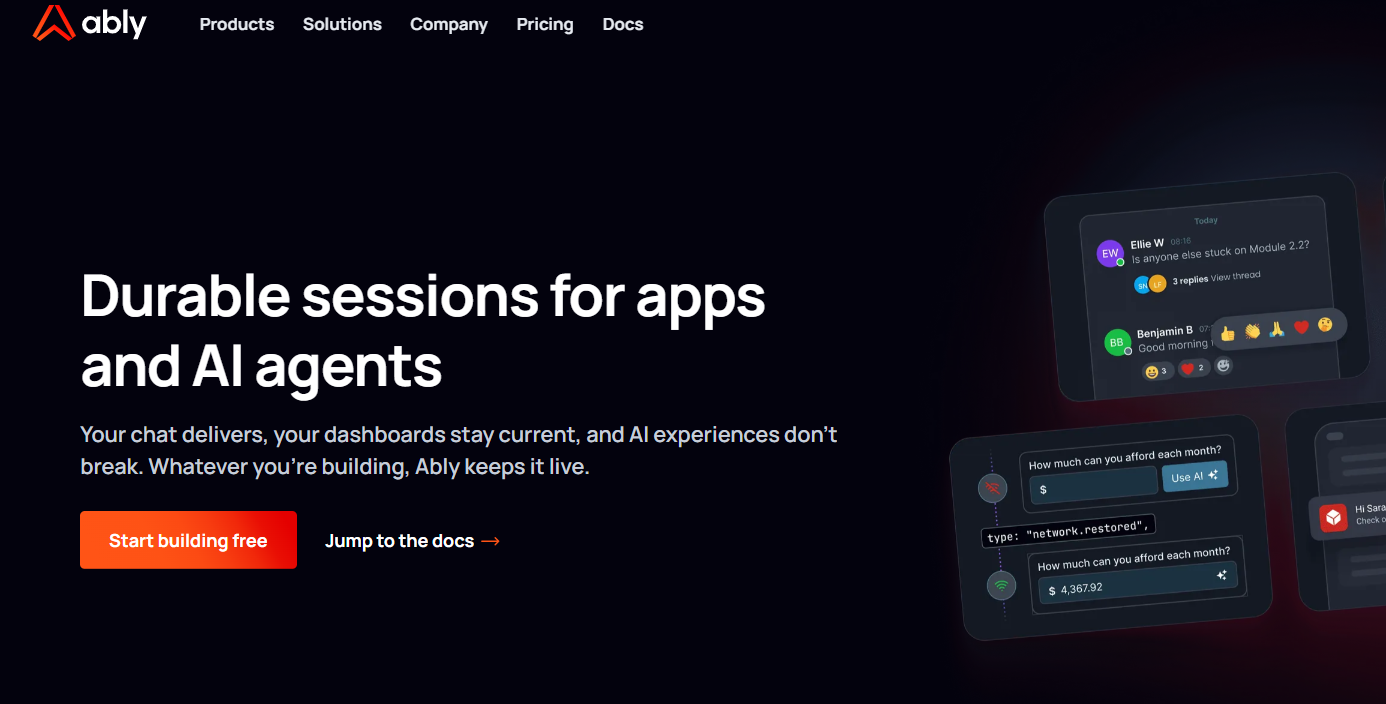
Ably's reputation is built on delivery guarantees: guaranteed message ordering, connection state recovery, and "four nines" reliability for infrastructure-sensitive deployments. For use cases where those properties are the primary requirement, it's a strong option.
For teams primarily focused on delivery guarantees, Ably is a strong infrastructure choice. However, its feature set is focused on the real-time signaling layer — social-layer primitives (friends, follows, group management) are not included and would need to be built on top. Teams moving from Sendbird for reliability reasons will find the infrastructure more consistent. Teams moving because they need a native social layer will still be building most of it themselves.
Stream
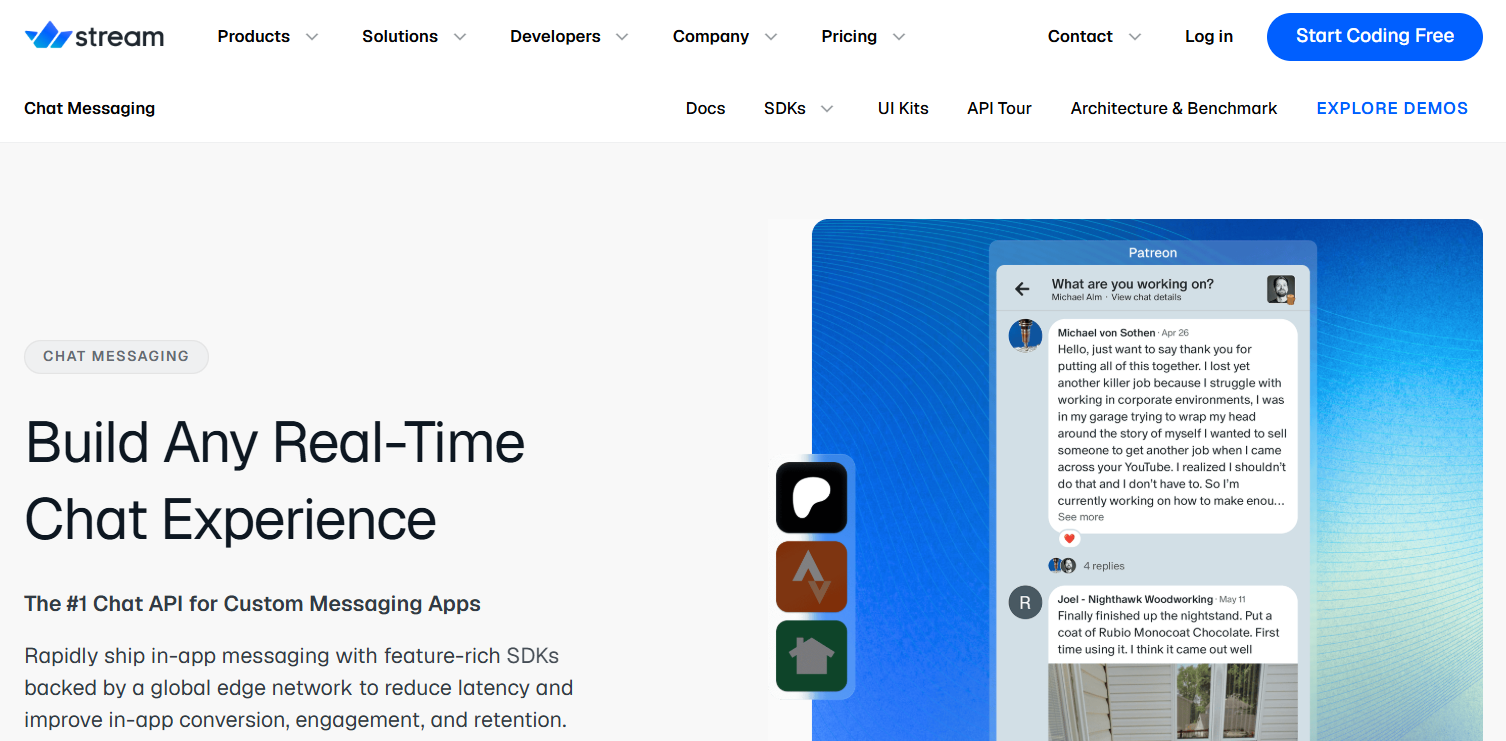
Stream has built a strong reputation in the developer community for API design quality and pre-built UI components. The UIKit is one of the better options in this category, and teams building social feeds alongside chat often find the abstractions fit naturally.
For more complex permission scenarios — multiple user roles, team-based access, or custom moderation workflows — teams may need additional development on top of Stream's core SDK. We recommend evaluating these edge cases against your specific product requirements.
Q1
What is the most cost-effective Sendbird alternative for scaling products?
The pricing gap between Sendbird and alternatives widens significantly at scale. Nexconn's entry point is $260/month versus Sendbird's $399, but the more meaningful difference appears in overage rates:
PCC Overage Rate
$0.90vs $5.00 (Sendbird)
MAU Overage Rate
$0.12vs $0.154 (Sendbird)
No Enterprise Feature Gating: Nexconn does not lock advanced features behind expensive Enterprise tiers, removing the need to pay for a higher MAU plan just to unlock a specific capability.
Q2
Which Sendbird alternative includes native social relationship management?
Among evaluated platforms, Nexconn includes the most comprehensive out-of-the-box social layer functionality:
Friend Management: Native add, delete, block, and request flows.
Advanced Social Logic: Per-member follow alerts, targeted group messaging, group ownership transfer, and four broadcast modes.
Competitor Comparison: Sendbird, PubNub, Ably, and Twilio require custom backend engineering for these features. Stream offers only partial coverage.
Q3
How does Nexconn handle large communities compared to Sendbird?
Sendbird's standard Group Channel supports up to 100 members. Nexconn supports 3,000 members natively out of the box.
Discord-Style Hierarchy: For community-scale products, Nexconn's Community Channels provide structured governance with sub-channels, roles, permissions, and persistent message history.
If you're evaluating the move, the In-App Connectivity Playbook 2026 covers the architectural decisions relevant to this kind of transition — channel architecture, social layer design, delivery optimization, and compliance requirements across different markets.
We'd love to discuss how Nexconn's real-time communication solutions can support your business. Request a demo, explore pricing, or get tailored onboarding guidance.