Solving Latency: Best In-app Chat SDK for Emerging Markets (2026)
Ryan Yang
Nexconn Infrastructure Engineer. Optimizes latency and scales microservices for hundreds of millions of concurrent users. Shares technical deep dives and backend lessons for zero-latency communication.
Whether you are scaling social interactions, AI agents, global gaming ecosystems, or on-demand delivery networks, the cross-border challenge in 2026 has shifted. It’s no longer just about localized content—it’s about the invisible communication infrastructure that keeps every interaction seamless.
Let’s be honest: finding a reliable In-app Chat API is easy until you actually try to scale. In the real-world networks of the Middle East and Southeast Asia, stability isn't a "nice-to-have"—it’s what keeps your app from being deleted. A chat app that freezes in an elevator is an app that gets deleted. If switching to 5G kills your messaging flow, users won't give you a second chance. Global expansion is a grind—you shouldn't be fighting your own backend. If the foundation isn't rock-solid, your growth hits a wall before the first month is up.
Nowadays, We have 5.5G in plenty of places. Average mobile speeds are hitting 85 Mbps. That sounds great on paper, right? But for an In-app Chat API, the "Last Mile" is still a total battlefield. In this era, it can be very hard for an app to survive the first month in a new market without a robust infrastructure.
The 2026 Shift: From Basic Tech to Total Immersion
The way the world connects is changing fast. It’s rewriting the rules of how we architect interactive products. Here is what is actually happening on the ground:
The Edge-Native World: Forget old-school CDNs. Now, we are talking about the "Edge." You have to be close to the user—like, real-timeclose. In a voice chat room for example, a few milliseconds of lag is the ultimate vibe-killer. It’s the difference between a natural conversation and that awkward "walkie-talkie" effect where everyone talks over each other.
Scaling for the Surge: Every app dreams of going viral, but few are actually ready for it. Social apps are the classic example of sudden, massive traffic spikes—like an influencer going live or a topic trending in minutes—but this "burst" reality applies to everyone. Whether it’s an AI tool hitting a usage peak or a social room exploding, your infrastructure needs to breathe. It shouldn’t just survive the crowd; it should scale with it instantly. You need anEnterprise Messaging API that reconfigures itself in a split second. It keeps virtual gifts and the chat moving without a hitch.
The Multi-Protocol Reality: In 2026, relying on a single transport protocol is a recipe for failure. Standard TCP was never built for the high-speed "handoff" between 5.5G and shaky Wi-Fi, often leading to that dreaded one-second disconnect that kills a session. While the industry is moving toward QUIC (HTTP/3) for its ability to migrate connections seamlessly, the reality on the ground is messier. Between ISP throttling and unpredictable firewalls, the "Last Mile" now demands a hybrid approach.
Lessons from the Battlefield: The Traps You Won't See on Google Maps
When you actually start running a business, the pitfalls become very real. These aren't just theories. These are stories from the trenches.
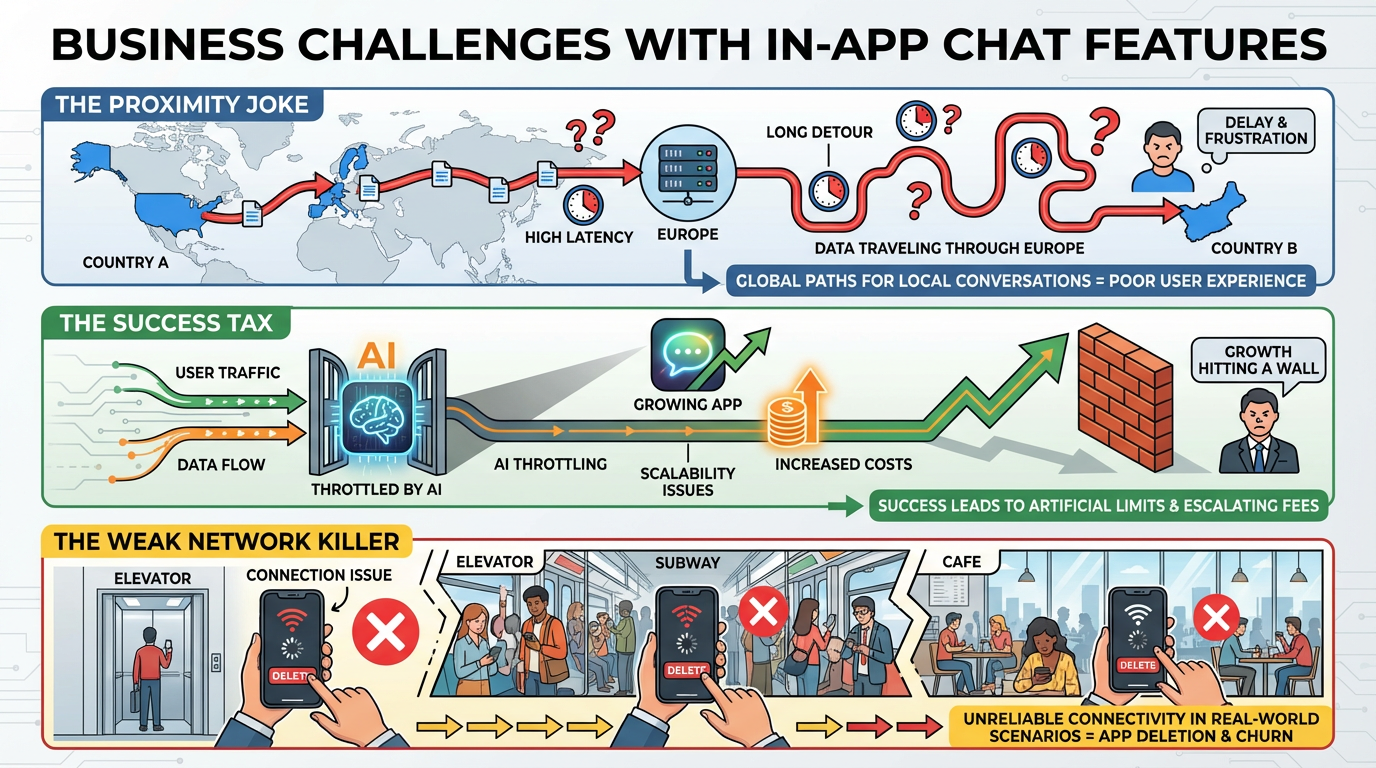
The Proximity Trap
I see this a hundred times. You look at a map. You see two countries right next to each other. You think, "Hey, the connection should be great!" Wrong. Because of how submarine cables work or how carriers negotiatepeering, data might take a detour. I've seen traffic between neighbors fly to Europe and back first. In a 1-on-1 chat, that means a huge delay. You can't just use one "global setting." You need a plan for every single carrier.
The "Success Tax"
Here is a weird one. Once your app gets big and actually starts making waves, the local networks might start to slow you down. I call it the "Success Tax." They use AI to find your traffic signature and throttle it. It feels like they are punishing you for being popular. If your Chat SDK lacks protocol obfuscation, your growth will hit a wall.
The Weak Network Killer
Socializing happens everywhere. Elevators, subways, or just a bad corner in a cafe. That "connecting..." spinner is the #1 reason people delete apps. Your In-app Chat API has to be "network-aware." It needs to reconnect almost before the user even knows the signal dropped.
The Nexconn Way: Making the Mess Disappear
After years in the trenches with developers, we know that a successful app is really about one thing: the feeling of seamless connection. To solve the "Last Mile" nightmare once and for all, we re-engineered the communication architecture from the ground up.
Predictive Multi-Link Strategy
No single cloud provider is the best in every country. That is just a fact. We mix multiple top-tier backbones into one giant, smooth network with proximity access points across the globe. By supporting dynamic selection and real-time dispatch, we ensure users connect to the fastest service point every time. With this foundation, our Chat SDK doesn't just wait for a link to die; it keeps the audio clear, even in a high-rise in Riyadh or a cafe in Brazil.
Liquid Protocol Stack
Instead of betting on a single protocol, we leverage a hybrid of TCP, UDP, and QUIC. If one protocol hits a wall, the system pivots instantly to another. It’s this "always-on" fallback logic that keeps our service at 99.99% availability, regardless of how messy the local network environment gets. For an app with a global user base, even a few minutes of downtime is a success-killer. We engineer for the edge cases so your business stays up when others blink.
Network Memory
Connections shouldn't start cold. We’ve built "Network Memory" into the core of our SD-CAN (Software Defined - Communication Accelerate Network). Instead of a fresh handshake every time, the system recalls the optimal path used previously by that specific user. It pre-empts the connection by predicting the best edge node before the first packet is even sent. This effectively erases the "handshake lag" that usually kills the user experience across long-distance links.
Protocol Obfuscation
To mitigate discriminatory throttling—where ISPs identify and limit high-growth app traffic—we employ advanced protocol obfuscation. By ensuring your traffic signatures align with standard HTTPS patterns, we effectively shield your data from intrusive Deep Packet Inspection (DPI). This not only safeguards user privacy but ensures consistent performance, preventing local networks from creating artificial bottlenecks.
The reality is, in 2026, you shouldn’t need to be a network specialist to ship a global app. When you plug in the NexconnChat SDK, all that messy stuff—the detours, the blocks, the throttles—just goes away. We take punches so your users can stay in the flow. 👇Leave your information below to talk to an engineer.
Contact us
We'd love to discuss how Nexconn's real-time communication solutions can support your business. Request a demo, explore pricing, or get tailored onboarding guidance.