What is a Chat API? And how to guarantee message delivery on any network?
Ryan Yang
Nexconn Infrastructure Engineer. Optimizes latency and scales microservices for hundreds of millions of concurrent users. Shares technical deep dives and backend lessons for zero-latency communication.
A Chat API is the backend engine that powers real-time messaging inside your app. It handles everything from sending a "hi" to delivering rich media, managing group conversations, and syncing messages across devices.
But here's the catch: a Chat API is only as good as its ability to deliver every message, on any network, anywhere. And that's where most solutions fall short.
To understand why, you need to look at the three transport protocols that power the internet—and their trade-offs.
TL;DR: TCP is reliable but slow on poor networks due to head-of-line blocking. UDP is fast but lossy—unsafe for chat alone. QUIC combines speed + security but faces firewall compatibility issues. Nexconn's hybrid protocol dynamically switches between TCP and QUIC, delivering 30% lower connection latency and 40% better performance in infrastructure-limited regions.
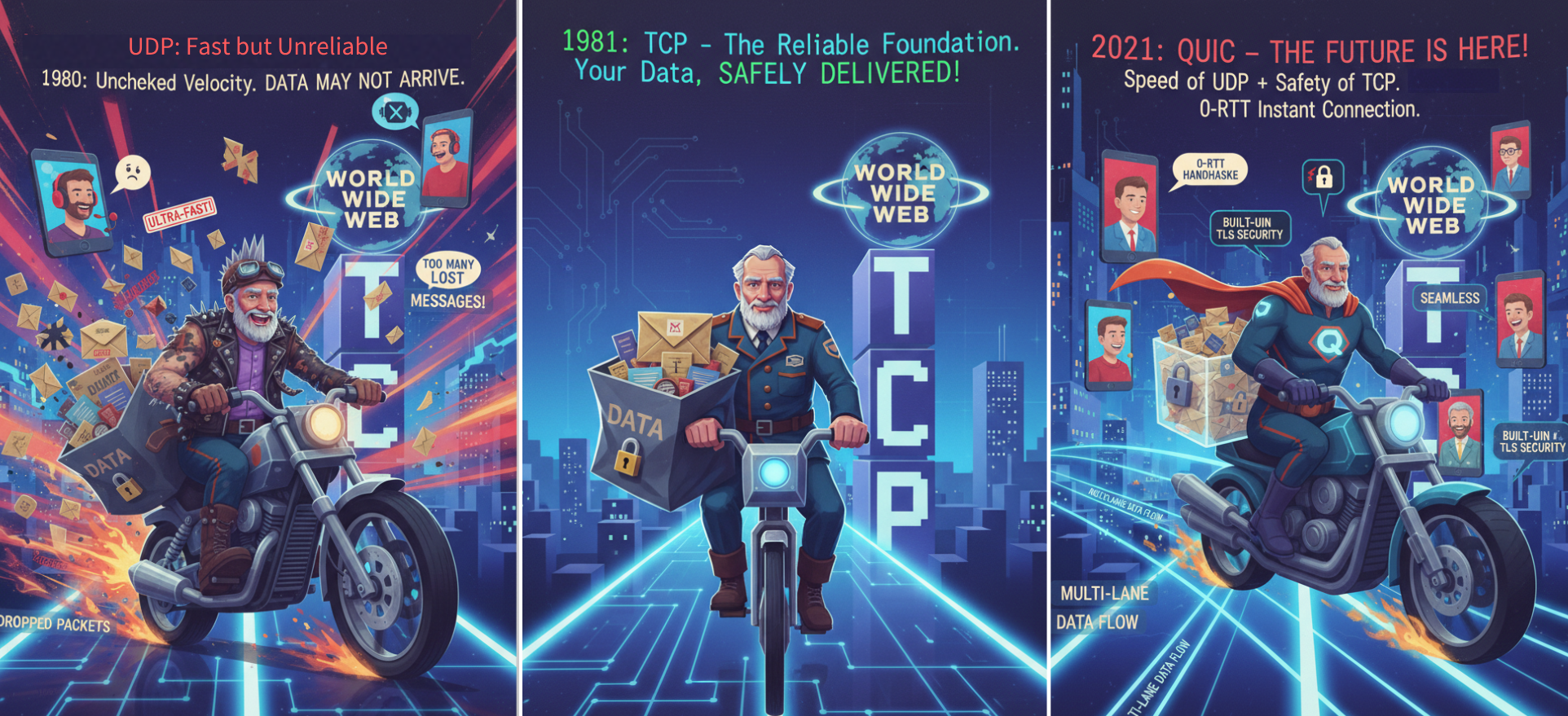
Back in the day, TCP served as the foundational pillar of the modern internet. It was created way back in 1981, and it makes sure your data arrives safely. It has supported the web for decades because of its reliability.
Today, however, mobile devices are the most common interface. We have extremely complex apps now. People use mobile data and they switch networks constantly. However, network conditions can be highly volatile. High ping, dropped packets, you know the deal. In these bad networks or long-distance internet trips, TCP actually has big problems. The handshakes take forever. If one packet drops, the whole line gets blocked. As a result, the smooth chat experience that users want today will definitely be ruined.
Then there is UDP. It came out in 1980 with a super simple design. It doesn't track complex connections like TCP does. It also doesn't promise that your data will actually arrive. But because of this, it is incredibly fast. Gamers and live streamers love it. But let's be real, you can't build a serious Chat SDK just on UDP. It loses too many messages.
So, Google made QUIC. I will call it a huge game changer. It takes the speed of UDP and the safety of TCP. It fixes that annoying blocking problem by sending messages on different tracks at the same time. Also, it connects instantly. 0-RTT technology delivers a seamless experience for users switching between Wi-Fi and mobile data networks. In 2021, QUIC officially became the base for HTTP/3. The whole tech world agrees that this is the future.
QUIC is just better than the old stuff. For example, TCP needs extra time to add TLS security on top. QUIC has security built right into it. You get speed and safety together.It also connects way faster. The very first time your app connects, it takes just one round trip (1-RTT). But if you connect again, QUIC remembers your old setup. It takes zero time (0-RTT). You can send your app data right away. It is 1 to 3 times faster than TCP+TLS.QUIC has a few more cool tricks:
Pick your traffic rules: QUIC defaults to standard congestion control algorithms like CUBIC. But since it works on the app layer, you can easily swap it out for others like BBR or Reno.
No HOL Blocking: QUIC gives each data stream its independent flow control window. If stream number 3 loses a packet, it only pauses stream 3. The other streams just keep going. This is a total lifesaver for Conversational AI, where multiple text and voice bits need to load at the same time.
Keeps you connected: QUIC uses a unique Connection ID. If you switch from Wi-Fi to 5G, the ID stays exactly the same. Your app doesn't disconnect. You won't even notice the switch.
But here is the real world problem. Millions of old routers and firewalls block QUIC or UDP traffic. TCP is still king everywhere. If an Enterprise Messaging API relies only on QUIC, some users just won't be able to log in at all. But keeping only TCP makes things too slow.
So, Nexconn did something really smart. We didn't just pick one. We integrated TCP’s universal compatibility with QUIC’s high-speed performance. The Nexconn private protocol runs both side-by-side. It adapts to your real network. If the network is good, it goes super fast. If you are on a bad network across the world, it smoothly switches to the best method. This gives users a smooth chat experience they don't even have to think about.
1.Protocol Hybridization: Engineering the TCP + QUIC Dual-Link Architecture
We want to combine TCP's reach with QUIC's power. It gives users a zero-delay feeling even in awful networks.
1.1 The Logic of Hybridization: Leveraging TCP's Reach and QUIC's Velocity
To fix the weak spots of using just one protocol, Nexconn built a smart two-track system. Your app keeps a super-safe TCP path and a blazing-fast QUIC path open. Because of QUIC's instant connect trick, the app uses old session info to send data immediately. The waiting time is virtually eliminated.
When you switch between Wi-Fi and mobile data, that Connection ID keeps your chat alive. Nothing drops. Also, if one packet gets lost, it doesn't block your whole chat app anymore.
The real-world results are impressive. For phone users, the connection wait time drops by 30%. The worse the network, the more significant the gain—with up to a 40% improvement in connection performance in infrastructure-limited regions. The servers handle significantly more traffic now.
1.2 Nexconn's Proprietary Binary Protocol
We also use a proprietary binary format for our messages. Older text-based protocols like XMPP are verbose and inefficient. We use a compact binary format. This reduces payload size by over 50%. This saves your phone's battery and your data plan. Our intelligent transport layer automatically switches between TCP and QUIC. Developers don't have to worry about complex networking details. They get high performance with minimal effort.
2. Winning the "Racing" Mechanism: Overcoming ISP Throttling and Global Latency
Network conditions vary widely. Some phone companies in different countries slow down UDP traffic on purpose. So, we employ a connection racing mechanism to ensure the lowest possible latency.
2.1 Dynamic Connection Racing: A Multi-Path Probing Strategy
Connecting is just a millisecond race. When your phone wants to connect, it asks multiple servers using TCP and QUIC at the exact same time. Our system grades them instantly based on speed and packet loss. The fastest one becomes the main link. We don't wait around anymore; we take action.
2.2 SD-CAN Architecture: Navigating the "Last Mile" with a Globally Distributed Backbone
SD-CAN (Software Defined Communication Accelerate Network) is Nexconn's global network backbone, purpose-built for real-time communication. It uses intelligent routing, global edge nodes, and real-time network telemetry to bypass congestion and reduce latency. In short, it makes the internet feel like a local network.
Physical distance causes lag. We use Anycast tech to route your app to the closest server node possible. It's like finding the fastest checkout lane. Our intelligent routing engine on the server side checks global network health all the time. It gives your app the best IP addresses to use. In bad networks, QUIC is usually 10% faster than TCP. But because different countries have weird rules, we use real-time tests and past data to make sure your global chat never fails.
3. Deterministic Delivery: Solving the Reliability Puzzle in UDP Environments
UDP is naturally messy. We built a rock-solid system on top of it to make sure data is as safe as a bank transfer.
3.1 Sequence-based Determinism: Achieving Zero Packet Loss and Perfect Order
To fix UDP's mess, Nexconn gives every single message a unique global ID (SeqID). This stops messages from arriving out of order. If you send a "hello", the server must reply "got it" (ACK). If it takes too long, we send it again using adaptive retry logic. And if the server gets the same message twice by accident, it just deletes the copy. Your In-app Chat stays perfectly clean.
3.2 The Smart Sync Model: Reducing Server Load while Ensuring Message Consistency
We use a push-and-pull design. When you are online, real-time messages are pushed to your phone instantly. If you go into a tunnel and lose internet, your app will check the ID numbers when you come back. It pulls only the missing messages to fill the gaps. We also use Protobuf to squeeze the data down as much as possible to save bandwidth.
4.Hardened Communication: Beyond the Limits of Standard SSL Armor
We go way beyond normal SSL rules, ensuring robust data protection.
4.1 Link Hardening: Implementing TLS 1.3 with Custom Handshake Obfuscation
Network safety is tough today. Nexconn uses the highest defense levels. For TCP, we force TLS 1.3. For QUIC, encryption is already baked in. It is like putting your data in a metal box. Nobody can spy on your plaintext.
4.2 True E2EE (End-to-End Encryption): Architecting a Vault that Even We Can't Open
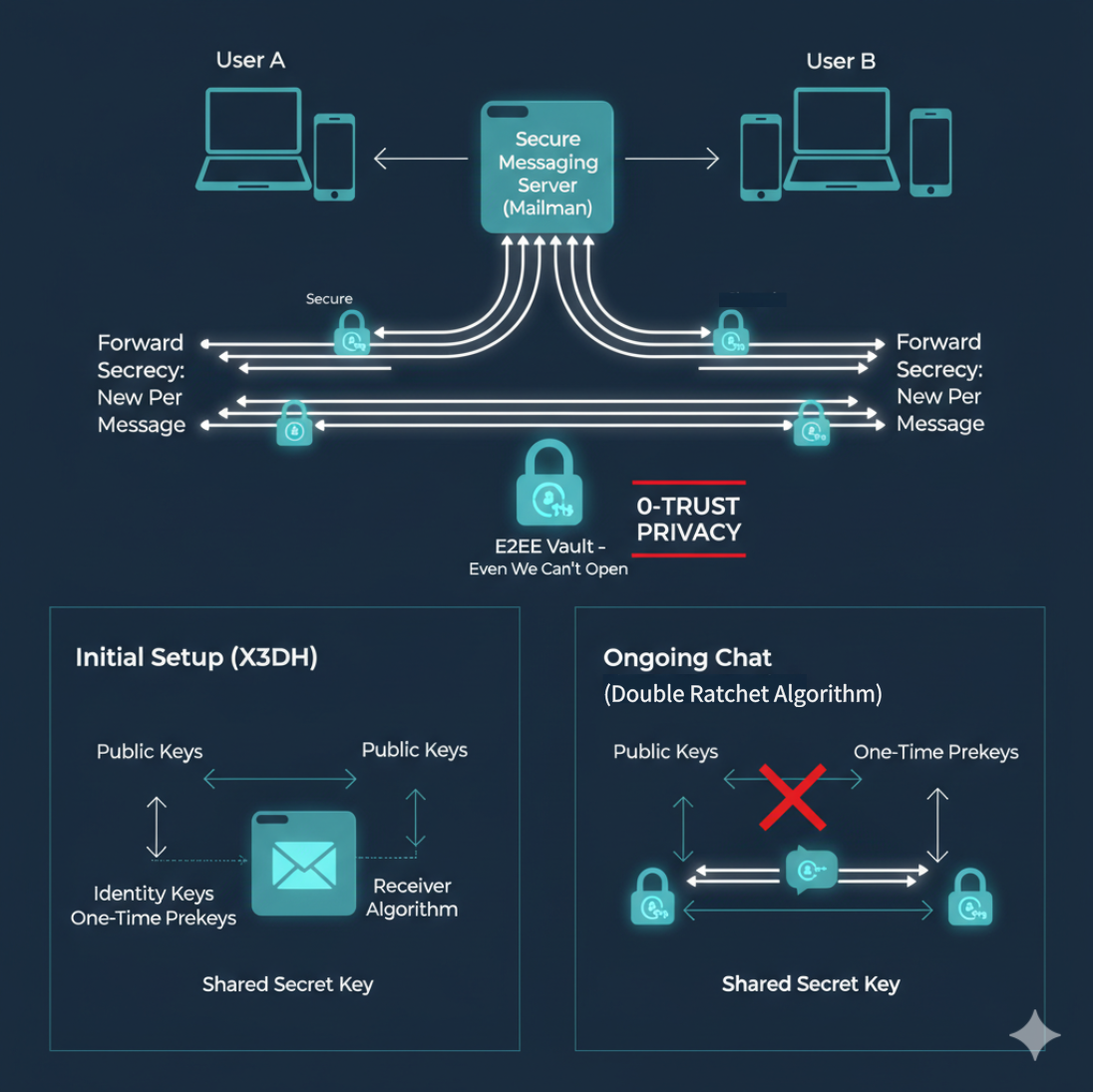
For super private business stuff, we use the famous Signal Protocol rules. We set up secret keys using X3DH and Double Ratchet algorithm. The coolest part? Every single message has its own new key (Forward Secrecy). Even if someone steals your private key today, they absolutely cannot read your old chats from yesterday. Our servers just act like mailmen passing locked boxes. We can't see anything inside. It is true zero-trust privacy.
Nexconn wants to give developers faster and stronger tools to build awesome apps. This whole protocol upgrade is just another way we are making communication faster, simpler, and better for everyone.
Ready to give your users the "zero-delay" messaging they deserve?
👇 Drop your details below to see our In-app Chat API and Enterprise Messaging solutions in action. Let's build something fast together.
Contact us
We'd love to discuss how Nexconn's real-time communication solutions can support your business. Request a demo, explore pricing, or get tailored onboarding guidance.