Let’s look at the world through the lens of 2026. The days of "easy money" in online shopping are over. For those in the e-commerce business, life is even harder. We call it the "Pressure Triangle." Why? First, ads are way too expensive. Second, people are holding onto their cash tighter. Third, everyone is selling the same stuff. Whether you are a big platform or a small brand, the game has changed.
Now, people want trust. They want help right away. A fast and friendly chat can be one of the reasons someone buys from you. So, In-app Chat is not just a side feature nowadays. How do you pick a Chat SDK that actually helps you sell more? Let’s dive in.
🛠️ Why In-app Chat is the Core of Your eCommerce Conversion Strategy
In the world of global eCommerce, your communication setup is your core infrastructure. When you are picking an Enterprise Messaging API or a Chat SDK, you can’t just look at a feature list and call it a day. You have to think about how it works on the ground. Here are the four areas where I see most businesses win or lose:
Rich Media and Interaction: Building a Virtual Storefront
A lot of people think chat is just about sending text back and forth. That’s a huge mistake. In the era of social commerce, your Chat SDK needs to be a "mobile counter." You need a super smooth experience for rich media—things like high-res GIFs of your products, "buyer show" videos, and even interactive cards.
Imagine being able to drop a product card directly into a chat with an actual "Buy Now" button. If the app feels laggy or if images take forever to load, the user is going to lose trust immediately. You need a base that can handle heavy traffic with almost zero lag, making sure the conversation feels as fast as talking in person.
Smart System Notifications: Your Private Marketing Engine
Don't treat system notifications like boring, cold alerts. In the right hands, they are a sniper rifle for your marketing team. A solid chat foundation lets you send "targeted pokes." For example, you could send a special coupon only to people who put an item in their cart but didn't pay.
Or, if an influencer is starting a live stream in five minutes, you can trigger a "live alert" for the specific segments most likely to convert. By leveraging smart notifications, your In-app Chat becomes a proactive engine that consistently drives user retention.
AI-Driven Sales: Scaling Support Without the Huge Headcount
You can’t pay a real person to sit around 24/7 in every single time zone. That will eat your profits alive. This is where Conversational AI comes in to save your skin. A smart bot can handle 80% of the repetitive stuff, like tracking a box or handling a basic return.
But for global brands, the real game-changer is real-time translation. If your team in one country can chat with a buyer in another language—and it feels totally natural—you’ve built instant trust. The trick is making the switch to a human feel invisible. When the bot hits a wall, it needs to hand the case over to a person in a split second, along with all the history, so the customer doesn't have to repeat themselves.
Omnichannel Reach: Meeting Customers Where They Already Are
Your buyers don't all use the same apps. If you are selling in Brazil, your customers live on WhatsApp. In Thailand, it's all about Line. You need an Enterprise Messaging API that acts like glue, sticking all these channels—WhatsApp, Zalo, Messenger, and even Email—into one smooth flow.
🆚 Nexconn vs. Sendbird, Twilio, PubNub, and GetStream: The 2026 Developer’s Guide
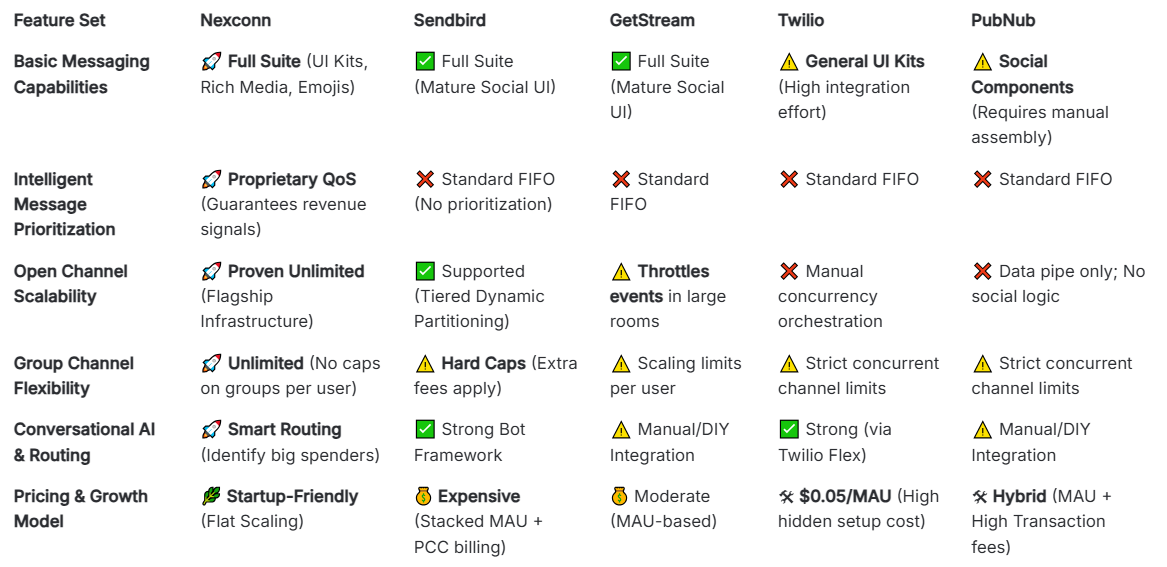
So, you are looking at your options. We put Nexconn next to Sendbird, Twilio, PubNub, and GetStream.
Here is the bottom line: Our audit shows that while Sendbird punishes your growth with heavy fees and Twilio/PubNub leave you with months of manual dev work, Nexconn provides the only all-in-one foundation that drives real conversions. Here is how they stack up:
Let’s break down these results to see how the technical differences between these platforms translate into saved dev hours, lower operational costs, and—most importantly—higher conversion rates for your platform.
Beyond Boring Text: Who Wins the "Interaction" Game?
In shopping, a chat message is a way to close a deal, not just talk.
The A-Team (Nexconn & Sendbird): These two are the real pros at rich media. GIFs, stickers, voice notes, and location sharing. They handle it all.
The Gaps: While old-school pipes like PubNub and Twilio can transmit data, they lack native UI-level support for things like stickers or rich product cards. To get a polished "typing indicator" or "user online status" on Twilio, your team will spend weeks on manual configuration and UI building. For developers who want that polished, "big-brand" feel without the heavy lifting, these missing UI layers are a major pain in the neck.
Social Commerce: Mastering the "Live" Experience
Live streaming and video consults are the new standard for global shops. In a high-pressure sale, the difference between a "sent" message and a "delivered" message is a closed deal.
Built for Massive Live Commerce: Nexconn’s Open Channel Advantage:
While others offer chat as a sidecar, Nexconn’s Open Channel is a flagship infrastructure used by the world's leading live-streaming platforms. It is engineered for massive, unlimited concurrency without the traditional "bottlenecks" that cause lag during peak traffic.
Most importantly, Nexconn offers Intelligent Message Prioritization—a proprietary capability that is currently absent from every other legacy provider in the market. While competitors like Sendbird, Twilio, and GetStream treat every data packet with equal weight, Nexconn understands the difference between "noise" and "revenue." In a room with millions of viewers, Nexconn ensures that business-critical signals—like a VIP’s purchase request or a flash-sale "buy" button trigger—are prioritized and guaranteed to deliver, even when the chat is being flooded with millions of emojis. This exclusive "High-Stakes QoS" (Quality of Service) makes it the only stack capable of protecting your leads during the most chaotic peak sales moments.
The Competitors:
GetStream is a social-first powerhouse, but it struggles with the "State Sync" demands of modern commerce. In a massive live-stream, updating a product card’s inventory or a flash-sale price across 50,000 viewers simultaneously often hits API rate limits or causes noticeable sync lag. Furthermore, their MAU-based pricing is a financial nightmare for e-commerce brands that experience massive, spiky traffic—you end up paying an entire month's premium for a single hour of peak traffic.
Sendbird's live streaming is often treated as a separate, costly module. To support massive, million-viewer audiences in its Open Channels, Sendbird forces you into complex tiered architectures like "Dynamic Partitioning" that can heavily penalize your growth with extra fees.
Twilio is great for custom builds, but it has zero "social commerce" templates or native massive-scale Open Channel tools out-of-the-box. You have to build your own live-shopping UI and handle the massive concurrency distribution yourself from scratch.
Conversational AI: Who is Actually Smart?
Everyone wants to save on staff costs with AI, but the "IQ" of these platforms varies a lot.
The Smart Trio:Nexconn, Sendbird, and Twilio are the leaders here. They fully support AI bots and Smart Routing. This is huge—it means the system can automatically spot a "big spender" in a chat and push them to your top sales person right away.
The DIY Trap: If you go with PubNub or GetStream, you’ll often find a "Build-It-Yourself" approach to AI. For a startup trying to launch fast, that is a massive trap you want to avoid.
🚀 Why Nexconn is the Secret Weapon for High-Growth E-commerce
If you’re building a brand from scratch, you don't just need a chat tool; you need something that won't "punish" you for being successful. In my years of looking at these platforms, Nexconn has five specific "killer" features that actually help you scale without hitting a massive financial wall.
Unlimited Groups: Scaling Your Community Without the "Growth Tax"
Most In-app Chat API vendors out there have a sneaky way of making money: they treat your growth like a premium feature. They usually put hard caps on the total number of groups users can create, or even more annoying, they limit how many groups a single user can join. If you want to break those limits to build a real social ecosystem, they’ll hit you with extra fees.
Nexconn takes a completely different road. Whether you need ten groups or more, and regardless of how many communities a single user wants to dive into, our Chat SDK handles it all without the extra bill.
Open Channels: Engineered for Massive Live Commerce
While groups are for communities, Open Channels are for the stadium-sized audiences of 2026 live commerce. Unlike standard chatrooms that lag or crash under pressure, Nexconn’s native "Open Channel" architecture supports unlimited members out-of-the-box.
But scale is only half the story. The real game-changer for eCommerce is our "Status Sync of Live Rooms." This allows your team to inject custom data payloads—like dynamic flash-sale prices, pinned product cards, or real-time SKU inventory updates—and broadcast those changes to millions of viewers instantly. To ensure this massive flood of data stays organized, Nexconn utilizes its proprietary Intelligent Message Prioritization, guaranteeing that while millions are chatting, your most critical revenue signals—like purchase requests—are delivered first and never lost in the noise. It turns a simple chatroom into a high-concurrency "mobile counter" where every viewer sees the same price drop at the exact same millisecond, without ever hitting a technical or financial wall.
Larger Payloads and Fair Pricing: A Roomier Foundation for Your Data
In the world of online shopping, chat history is your ultimate safety net. It’s the foundation of trust. If a buyer and seller get into a dispute over a return, you need to be able to look back and see exactly what happened.
But here is where Nexconn really stands out: our In-app Chat API supports substantially larger message payloads. While competitors often restrict custom data or charge premiums for anything beyond basic text, Nexconn gives you the room to pack business-critical data—like SKUs, tracking metadata, or custom order details—directly into the chat object.
This leads to the most important factor: the bill. Legacy providers like Sendbird often use a complex, "stacked" pricing model—charging you for Monthly Active Users (MAU), Peak Concurrent Connections (PCC), and essential feature add-ons separately. For a growing brand, this unpredictability leads to "bill shock" where your costs skyrocket the moment you start to succeed.
Nexconn is built to be a partner, not a tax collector. We offer a much lower entry barrier, making it highly accessible for startups and early-stage shops to get enterprise-grade tools from day one. As you scale, our pricing remains predictable and controllable. We don't believe in punishing you for being successful; we ensure that as your traffic grows, your margins stay protected.
Smart Push: Turning "Annoying" Notifications into Sales
Most people think of notifications as those pestering pop-ups. But with the right Chat SDK, they become a high-precision selling tool.
Instead of blasting your whole user base, Nexconn’s system allows you to send a deal only to a specific niche. This makes your messages feel personal rather than like spam. It’s also a lifesaver for live shopping. If an influencer is going live in five minutes, you can instantly ping everyone who follows them. Since this is all part of the Enterprise Messaging API, you don't have to waste months building your own complex alert system. It just works.
Built for Builders: Flexible APIs That Actually Adapt to Your Business
Let’s be real: most In-app Chat API providers want you to build your business around their logic. Nexconn takes the opposite approach with its Enterprise Messaging API design.
The Bridge to Everywhere: Instead of locking you in, Nexconn gives you the tools to bridge your app’s chat with external worlds. If your business relies heavily on WhatsApp, you can use our flexible interfaces to sync your internal chat flows with WhatsApp Business API seamlessly.
No More "Dead Ends": Whether you need to trigger a custom loyalty reward or integrate a local third-party payment gateway right into the message bubble, the API doesn't get in your way.
Frequently Asked Questions
Why does in-app chat matter for e-commerce conversion rates, not just customer support?
Because the moment a user has a question and can't get an immediate answer, they leave. In physical retail, a sales associate can intercept hesitation in real time. In-app chat replicates that dynamic digitally — a well-timed response to a product question, a coupon pushed to a user who abandoned their cart, or a live consultation that resolves a sizing concern can each directly close a sale that would otherwise be lost. Chat isn't a support tool in this context; it's a conversion layer sitting on top of your product catalog.
What's the difference between using chat for notifications versus using it as a marketing engine?
Standard notifications are broadcast messages — the same content sent to everyone. Using chat infrastructure as a marketing engine means sending targeted interventions based on user behavior: a cart abandonment coupon sent only to users who added items but didn't purchase, a live stream alert sent only to followers of a specific influencer, a flash sale price update pushed to users currently browsing a product category. The underlying infrastructure is the same, but the difference in conversion impact is significant because the messages feel relevant rather than intrusive.
What is Intelligent Message Prioritization and why does it matter during live commerce events?
In a live shopping event with millions of concurrent viewers, the chat stream is flooded with emoji reactions, casual comments, and viewer messages. Mixed into that noise are revenue-critical signals — a VIP's purchase request, a flash sale trigger, a "buy now" button click. Standard chat infrastructure treats every packet equally, which means those high-value signals can be delayed or lost during peak traffic. Intelligent Message Prioritization ensures business-critical messages are processed and delivered first, regardless of how chaotic the chat volume gets. This is the difference between a closed sale and a missed opportunity at exactly the moment your traffic is highest.
How does Nexconn's pricing model differ from Sendbird or other legacy providers?
Sendbird and similar platforms use stacked pricing — charging separately for Monthly Active Users, Peak Concurrent Connections, and feature add-ons. For e-commerce brands with spiky, event-driven traffic, this creates unpredictable bills: you pay a full month's premium for a single hour of peak activity. Nexconn's pricing is designed to stay predictable as you scale, without separate charges for concurrent connections or feature unlocks. The practical result is that growth doesn't trigger unexpected cost spikes at the moment your business is performing best.
Why do PubNub and Twilio require significantly more development time for e-commerce use cases?
Both platforms are infrastructure pipes — they transmit data reliably, but they don't provide the product layer that e-commerce requires. Features like typing indicators, online status, rich product cards, sticker support, and interactive message components require weeks of manual UI development on top of a raw messaging API. For a team trying to launch quickly, that development overhead is a meaningful time-to-market cost. Platforms like Nexconn and Sendbird provide these components natively, which is why the developer audit shows a significant difference in setup time.
How does real-time translation work in a customer support context, and what makes the bot-to-human handoff critical?
Real-time translation allows a support agent in one country to handle customer inquiries in another language without the conversation feeling mechanical or delayed. The translation happens in the message layer before the text renders on either side. The handoff quality matters equally: when an AI bot reaches the limits of what it can handle and escalates to a human agent, that agent needs the full conversation history transferred instantly. If the customer has to repeat themselves, trust erodes immediately. The handoff should be invisible from the customer's perspective.
What does "Status Sync of Live Rooms" mean in practice for a flash sale?
It means that a price change, inventory update, or product card update is broadcast to all viewers simultaneously — not sequentially. In a room with 50,000 concurrent viewers, a standard chatroom architecture processes updates sequentially, which means early viewers see the new price before late ones, creating inconsistency and potential disputes. Status Sync ensures every viewer sees the same flash-sale price at the same millisecond, which is both a technical requirement and a trust requirement for live commerce.
Why are group limits a hidden growth problem for social commerce platforms?
Most chat providers cap the number of groups a user can join or limit the total number of groups on the platform. For an e-commerce platform building community features — brand fan groups, product discussion rooms, buyer circles — hitting those limits forces a choice between paying overage fees or restricting user behavior. Either outcome damages the product experience. Platforms that impose group limits are effectively charging you for community growth, which is the opposite of what a commerce infrastructure partner should do.
👇 Ready to see Nexconn in action? Leave your details in the banner below. Our experts will reach out to help you design a Chat SDK strategy that actually drives revenue.
Contact us
We'd love to discuss how Nexconn's real-time communication solutions can support your business. Request a demo, explore pricing, or get tailored onboarding guidance.