Looking to skip months of chat backend engineering without enterprise pricing? Explore our Production-Ready Free Chat API (10K MAU) — full Pro-tier power, multi-channel push, and zero credit card required.
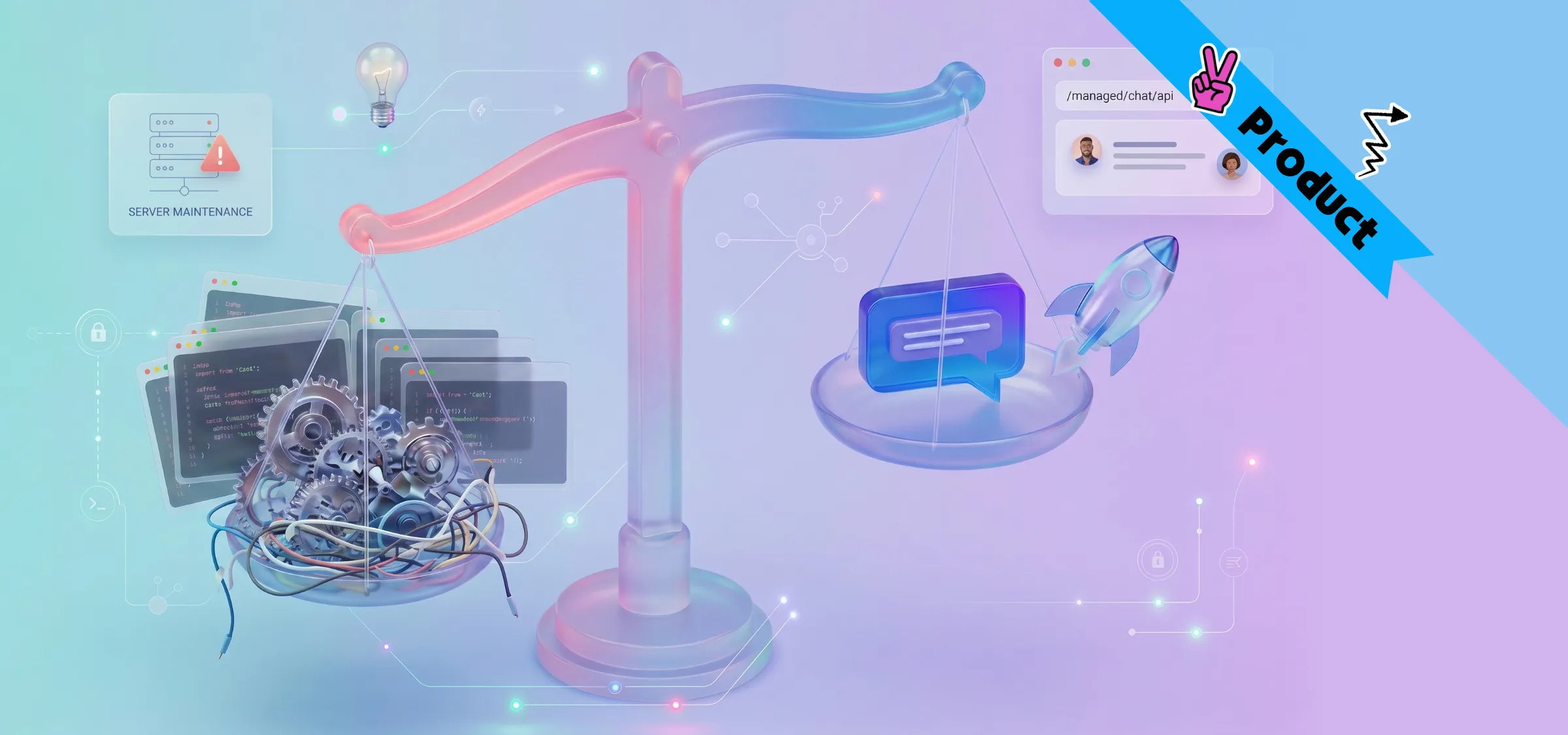
Opting for an in-house build versus a managed API is a high-stakes crossroads for any roadmap. The true costs are usually buried under years of maintenance, shifting security mandates, and the technical friction of scaling across global regions.
This 2026 guide explores the "Build vs. Buy" chat debate through the lens of Total Cost of Ownership (TCO), helping CTOs and engineering leaders avoid the trap of technical debt while accelerating time-to-market with Nexconn's high-performance messaging stack.
How Chat APIs Work: Core Functions and Architecture in Modern Apps
Chat's visible surface — a text input, a message list, a read receipt — is maybe 10% of what a production chat system has to handle. The other 90% is invisible to users until it breaks.
Engineering Pillar
Technical Complexity
Common Self-Built Failure
Message Reliability
Local caching during signal blackouts; atomic ordered flushes once handshakes stabilize.
Dropped messages, duplicates on retry, or "vibe-killing" out-of-order delivery.
Connection Persistence
Silent reconnections during constant WiFi/cellular handoffs.
Users see constant loading spinners or lose conversation threads during transit.
Android Push Fidelity
Bypassing aggressive battery optimization on non-stock skins (Vivo, Oppo, Xiaomi).
Notifications work on Pixel/Emulator but are silently killed on 70% of real-world global devices.
Presence at Scale
Managing real-time "typing..." fan-out across 100k+ concurrent sockets.
The "broadcast storm" saturates naive implementations, leading to massive server lag.
History & Search
Synchronized pagination and cross-device state for 10M+ queryable logs.
Inconsistent history between mobile and web; slow queries as database volume grows.
Content Moderation
Infrastructure-level interception of harmful content before delivery.
Post-delivery review is too slow to stop real-time harm or coordinated scam scripts.
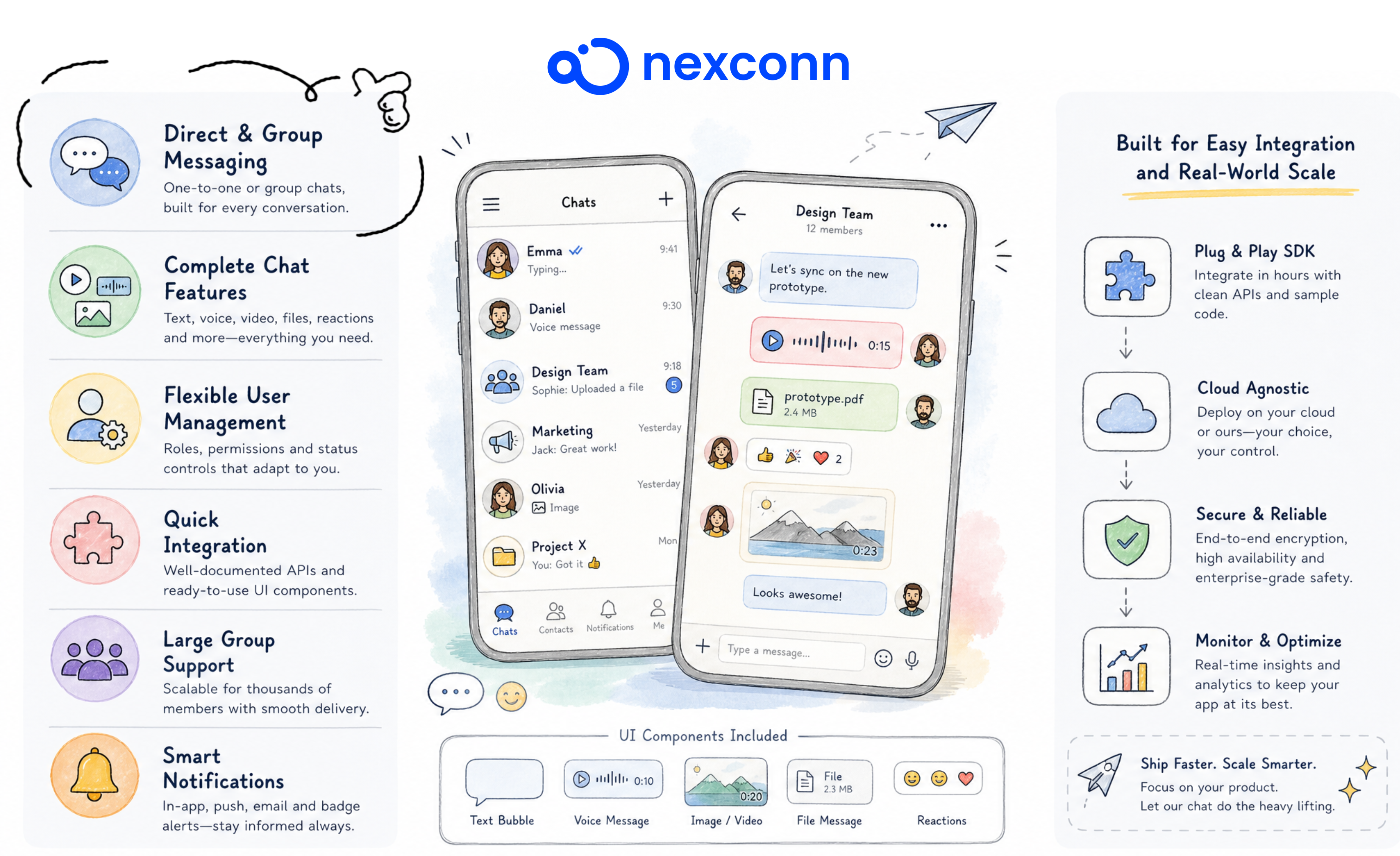
A Chat API handles all of this as infrastructure. Your team consumes it through an SDK and focuses on the product experience on top of it. That's the value exchange — not just the message routing, but everything underneath.
Building vs. Buying Chat Infrastructure: A 2026 Total Cost of Ownership (TCO) Analysis
The table below breaks down what "building it yourself" actually means across the dimensions that matter for a production deployment.
Dimension
In-House Development
Third-Party Chat API
Initial build time
3–6 months for basic functionality; 12+ months for production-grade
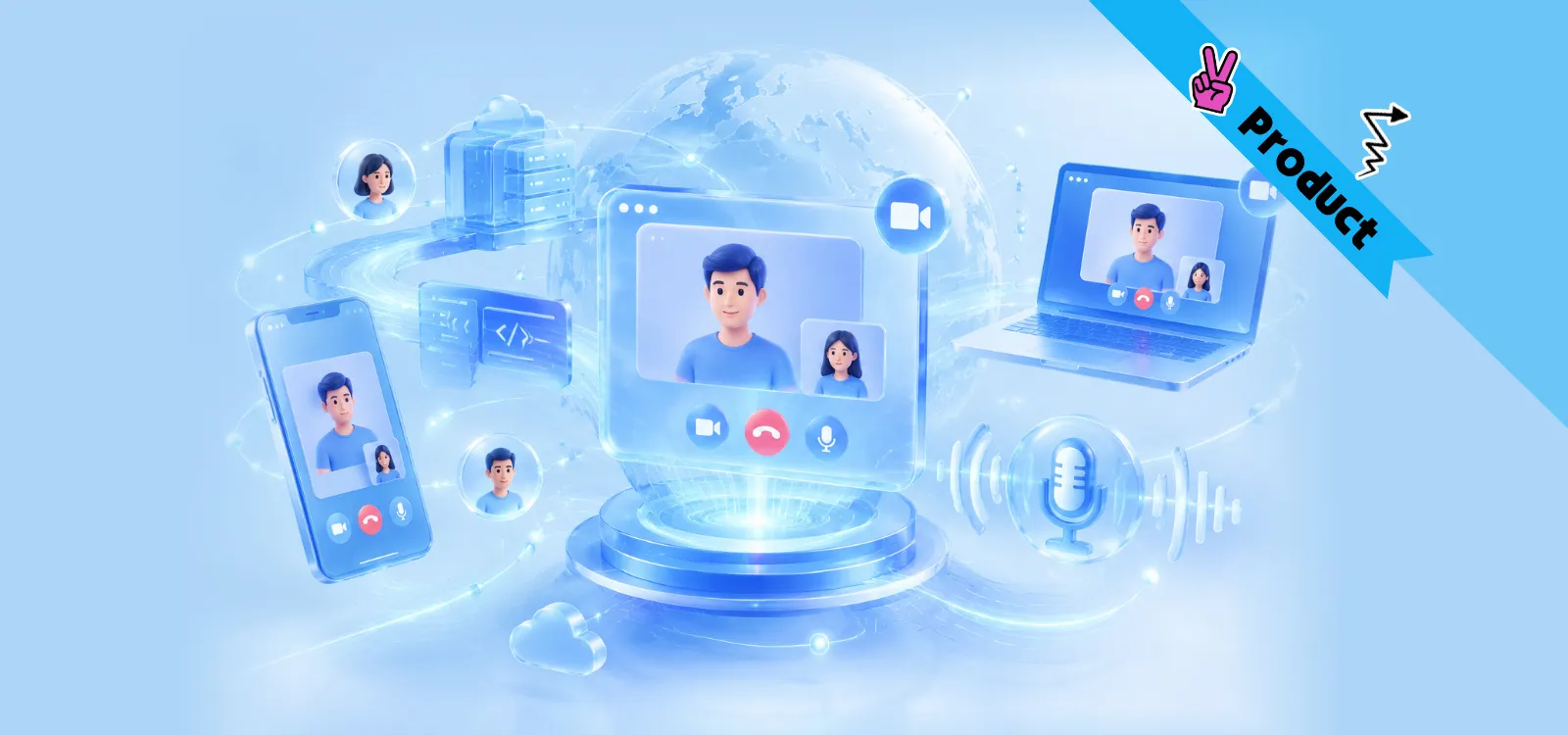
The hidden cost of an in-house build is the "innovation wall". When your roadmap inevitably expands to include audio/video calling, a self-built chat backend often lacks the hooks for RTC integration. Understanding the complexity of the next step is crucial—see our guide on Scaling WebRTC for Real-Time Communication to see what lies ahead.
Why Leading Platforms Choose Third-Party Chat APIs: Strategic Benefits & ROI
The "build vs. buy" question has a long history in software, and the answer has shifted significantly over the past decade. A generation ago, building infrastructure in-house was often the only viable option for anything beyond the simplest use cases. Today, the calculus looks different.
The reliability bar has moved. Users compare every chat experience to WhatsApp and iMessage. They don't have explicit expectations about latency or delivery guarantees — but they notice immediately when something feels off.
Time-to-market is a competitive variable. In most consumer product categories, shipping six months later than a competitor has measurable consequences.
The maintenance tail is longer than the build. A chat server that works in staging will encounter failure modes in production that nobody anticipated. Each one requires investigation, a fix, a deployment, and a regression test. That's ongoing engineering capacity committed to infrastructure rather than product.
Compliance requirements are expanding. GDPR, HIPAA, PDPA, local data residency laws — these aren't static requirements. They evolve, they vary by market, and they require ongoing attention.
Emerging market performance requires dedicated infrastructure. If your users are in SEA, MENA, or LATAM, a standard CDN won’t save you. Low-latency messaging in these territories is notoriously difficult. We’ve documented how these challenges manifest in specific regions in our Middle East Voice Social Infrastructure Case Study.
The Nexconn Edge: Scalable Chat Infrastructure Designed for Maximum ROI
Most chat APIs solve the basic infrastructure problem. Where Nexconn's positioning differs is in the product layer above that infrastructure — the capabilities that usually get categorized as "we'll build that later" and then become long-running engineering projects.
The social layer is native, not custom
Friend management — add, delete, block, and request flows — ships as an API capability. Group ownership transfer. Per-member follow alerts that bypass group-level DND settings. Targeted messaging to selected group members without broadcasting to everyone. Four broadcast modes covering all users, online users only, tag-filtered segments, and all active chatrooms simultaneously.
On a platform that doesn't include these, each item is a separate backend engineering project.
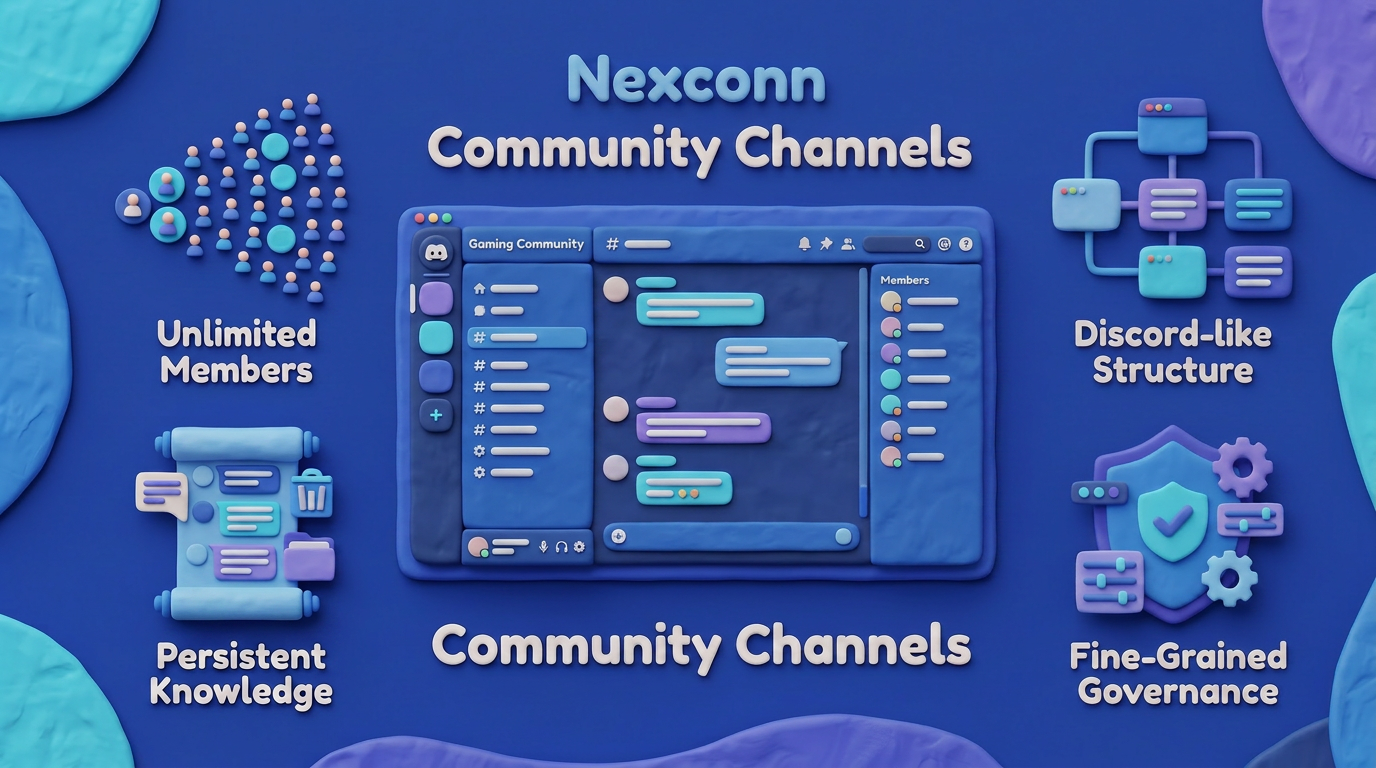
Community Channel architecture
Nexconn's Community Channels provide the governance depth that large communities actually need: public and private sub-channels, role-based member permissions, private channel member management, channel user groups, and persistent message history at the sub-channel level. This is Discord-style community architecture that platforms would otherwise build from scratch — or not build at all, because the engineering cost is prohibitive.
Live social infrastructure
Open Channel architecture with chatroom message whitelisting and message priority management. In a high-load live room, the platform inevitably starts dropping messages when capacity is exceeded. Without priority management, it drops blindly. Nexconn's system intelligently deprioritizes non-critical data while preserving high-value signals during traffic spikes. For live commerce and voice social platforms, this has direct revenue implications. The Best Chat API for Live Streamin article covers this in detail.
Security without custom implementation
TLS 1.3 transport encryption, X3DH protocol for E2EE session initialization, Double Ratchet for ongoing message encryption with forward and backward secrecy, and full local database encryption on-device. The cryptographic architecture that would take months to implement correctly is provided at the SDK layer.
Operational visibility
Polaris, Nexconn's native monitoring system, provides real-time data on message delivery rates, connection health, and latency distribution. For teams running production platforms, this level of observability typically requires assembling a separate stack of third-party tools. Nexconn includes it as a standard capability.
Infrastructure built for where users actually are
The SD-CAN (Software Defined - Communication Accelerate Network) network's sub-120ms end-to-end latency standard isn't a benchmark number achieved under ideal conditions — it's the operational standard across 3,000+ nodes in 233 countries. For products serving users in Southeast Asia, the Middle East, or other markets where standard CDN routing introduces meaningful variability, this is the difference between a product that feels fast and one that doesn't.
Frequently Asked Questions
Is it ever worth building in-house?
For most commercial products, the engineering cost of building production-grade chat infrastructure, including delivery guarantees, mobile push handling, weak network resilience, and the ongoing maintenance that follows, exceeds the cost of a third-party API by a significant margin. The more relevant question is usually what the engineering team's time is worth relative to what a Chat API subscription costs.
Does using a Chat API mean giving up control over data?
Not necessarily. Platforms like Nexconn operate regional data centers that allow data to be stored and processed in the region where users are located, satisfying data residency requirements in Southeast Asia, the Middle East, Europe, and other markets with explicit regulations. The compliance architecture is inherited rather than built, but the data sovereignty controls are real.
What compliance certifications does Nexconn hold?
Nexconn's infrastructure is designed to align with GDPR and HIPAA requirements, and supports regional data center deployment for local data residency compliance. These are inherited by platforms built on Nexconn's infrastructure rather than requiring separate compliance implementation.
Contact us
We'd love to discuss how Nexconn's real-time communication solutions can support your business. Request a demo, explore pricing, or get tailored onboarding guidance.