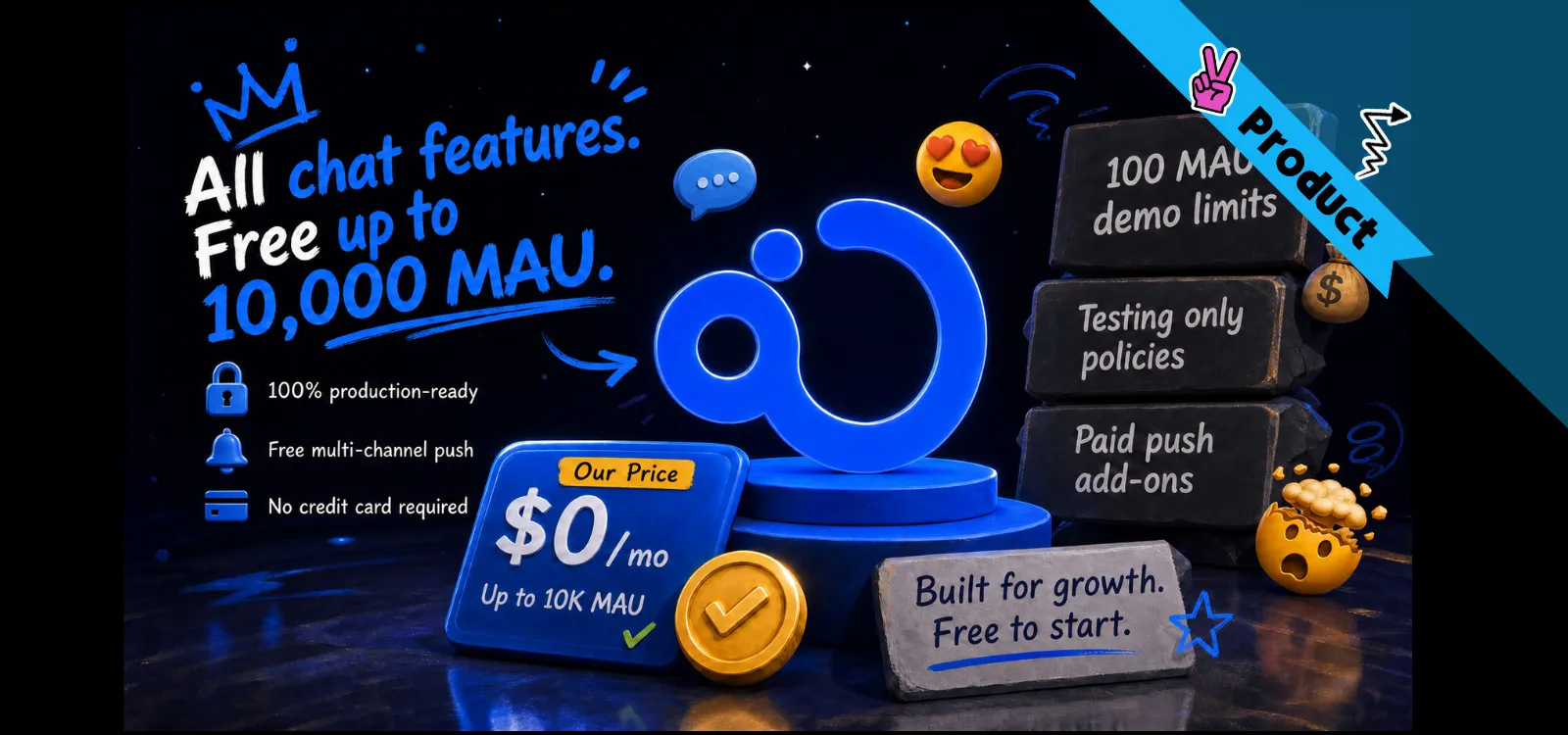
Why pay Stream Chat $4,788/year for 10K MAU — and still pay extra for push notifications? Get that exact same 10,000 MAU capacity with native push included at $0 using our Free Stream Chat Alternative (10K MAU).
Stream Chat (commonly called GetStream) didn't win over the developer community by accident. The API is slick, and the documentation is detailed enough to actually be useful. However, the real engineering friction often arrives only after you've scaled. Whether it's managing costs during viral growth events, or building complex social hierarchies on top of a platform that doesn't include them natively, teams are finding that Stream's messaging-first approach requires significant custom engineering at scale.
In 2026, choosing a Stream Chat alternative is about moving to a social-native infrastructure that actually supports the weight of a million-member community.
The 2026 Audit: Best Stream Chat Alternatives for Social and Live Apps
Nexconn
Built for products where the communication layer is the product itself — social apps, gaming communities, live streaming platforms, marketplaces where user relationships drive retention.
Nexconn eliminates the "integration tax" by shipping a native social fabric that Stream lacks. Relationship primitives like friend management, relationship blocking, and group ownership transfers are built-in API calls, not custom backend projects. Our broadcast infrastructure handles everything from all-user announcements to targeted tag-based segments natively, ensuring your engineering team can stay focused on your core product instead of the plumbing.
Nexconn vs Stream — Where the Gaps Are Largest
Feature / Capability
Stream
Nexconn
Nexconn Capability
Friend Management System
Requires custom development
Native API
Native handling of friend requests, deletions, and lists. Saves building a separate social DB.
Atomic Group Transfer
Requires custom development
Supported
One-click transfer of ownership. Essential for community continuity in gaming and business.
Special Follow (Group Member)
Requires custom development
Supported
Allow users to follow specific members to bypass DND. Perfect for high-priority coordination.
Targeted Group Messaging
Requires custom development
Supported
Send messages to select members in a group. Reduces noise and enables role-based alerts.
All-User Broadcast
Requires custom development
Native Engine
Push service-wide operational notifications to the entire user base with a single API call.
Online-User Broadcast
Requires custom development
Native Engine
Instantly notify currently active users for time-sensitive events or maintenance alerts.
Tag-Based Broadcast
Requires custom development
Native Engine
Segment users by custom tags for precise, high-conversion marketing and operational outreach.
All-Open-Channel Broadcast
Requires custom development
Native Engine
Essential for live streaming platforms to push global host announcements or system-wide gift signals.
Public & Private Sub-Channels
Requires custom development
Supported
Discord-style community architecture with native permission logic for tiered engagement.
Community Channel User Groups
Requires custom development
Supported
Batch permission management for different tiers of large-scale community members.
Open Channel Whitelist
Requires custom development
Supported
Ensures host and moderator commands cut through the noise during massive traffic floods.
Open Channel Message Priority
Standard (no native prioritization)
Supported
Dynamic priority protects revenue signals (gifts) from being dropped under extreme load.
Open Channel Instance Limit
250k limit
Unlimited
Built for platform-scale growth without instance capacity ceilings.
User Blocklist Limit (1:1)
Not included by default
3,000 / User
Ensures safety and harassment control at enterprise scale without custom backend.
Native Health Monitoring
Requires third-party tools for observability
Polaris (Built-in)
Real-time visibility into message latency and connection health directly from the dashboard.
Sendbird
Sendbird is a well-established choice for procurement-heavy organizations, backed by solid documentation and broad SDK support. However, its PCC overage rate of $5.00 per connection is significantly higher than Nexconn's $0.90 flat rate — a difference that can translate into substantial cost savings for teams experiencing viral growth.
PubNub is a world-class message bus built primarily for IoT and data streaming — use cases with very different requirements from social interaction. Their per-request billing model can make costs harder to forecast as usage patterns evolve — a factor that teams should model carefully against their expected engagement. Without a native social layer or UI kits, your engineers end up doing the heavy lifting of building a product on top of their raw "pipe."
Twilio makes sense for vendor consolidation if you're already locked into their SMS and Voice ecosystem. However, Twilio's in-app chat has been part of a broader omnichannel messaging strategy since the Programmable Chat sunset — a strategy that prioritizes integration with SMS and Voice over deep social engagement features. Between the lack of a native social graph and the absence of specialized UI kits, teams building social-first products often find that Twilio's feature set doesn't match their needs as closely as purpose-built solutions.
Ably is rock-solid for raw data integrity, but it's important to distinguish between a real-time transport layer and a complete chat solution. They provide a reliable real-time transport layer, but the social-layer features — friend lists, blocking, community governance — still need to be built on top. It lacks social-layer features that modern discovery apps demand—meaning no native friend lists, no built-in blocking, and basic UI components only for React. Lacks multi-platform native UI kits.
Frequently Asked Questions
Q1
Why are high-growth teams moving away from Stream Chat (GetStream)?
While Stream is excellent for rapid prototyping, developers often hit a technical ceiling as they scale. The most common pain points include:
Lack of a Native Social Layer: Requires custom backend development for basic friend management and blocking.
Hard Limits: Architectural ceilings on maximum channel counts.
Connection-Based Pricing: Per-connection overage fees that can increase significantly during viral growth events — a factor teams should model against their expected scale.
The Nexconn Solution: Provides a social-native engine that handles the complex business logic of user relationships natively.
Q2
Does Nexconn offer native relationship management features that Stream lacks?
Yes. Unlike Stream's messaging-first approach, Nexconn ships with a complete Native Social Graph.
Built-in Social Primitives
Friend request flows, user blocking, and group ownership transfers via native API calls.
Eliminates "Integration Tax"
Saves months of backend engineering debt by removing the need for a parallel social database.
Q3
How does Nexconn handle massive live event traffic compared to generic APIs?
During high-concurrency traffic spikes, message delivery reliability can become a concern without native prioritization.
Intelligent QoS Engine: Nexconn's Open Channel architecture features an intelligent Message Prioritization (QoS) engine that ensures revenue-critical signals (e.g., host announcements, gift transactions) are prioritized over low-priority noise during peak activity.
Q4
Is it possible to build Discord-style community structures using these SDKs?
Not natively on Stream or Sendbird, which rely on flat channel models lacking native hierarchy.
Native Community Channel Architecture: Nexconn supports public & private sub-channels, role-based permission inheritance, and persistent sub-channel history out of the box — perfect for gaming guilds and large social ecosystems without custom code.
For a complete blueprint on managing global chat architecture and delivery optimization, access our latest resource before we dive into platform specifics:
We'd love to discuss how Nexconn's real-time communication solutions can support your business. Request a demo, explore pricing, or get tailored onboarding guidance.