The number on a chat SDK's pricing page rarely tells the full story about what you'll pay in month eight. What actually determines your cost curve is the billing unit underneath it — MAU, transactions, concurrent connections, or a flat tier — and that unit is set before you sign up, not something you can renegotiate once your product starts growing.
While most chat infrastructure providers package their plans into monthly tiers, the underlying metrics they meter vary significantly.
In practice, your long-term cost curve is defined by four primary billing structures:
MAU-based billing counts monthly active users and charges per user, typically with unlimited messaging bundled in. Sendbird, CometChat, Stream, and Nexconn all use this as their primary model. It's the easiest structure to reason about in advance, since MAU is usually a number product teams are already tracking for other reasons.
Transaction-based billing dressed up as MAU is PubNub's approach. The pricing page shows a MAU figure, but the underlying meter counts transactions — messages sent, messages received, presence events — and a heavy user can be billed as the equivalent of several MAU. The headline number and the real cost driver aren't the same thing.
Concurrent-connection billing as a second layer shows up alongside MAU pricing on most of these platforms. Flat-rate tiered pricing appears at the higher end of most of these vendors' plans — a fixed monthly fee bundling a defined MAU allowance, a support tier, and a feature set, with the price jumping in steps rather than scaling smoothly.
Free Tiers vs. Real Growth: The 12-Month Cost Curve
Before looking at the cost curve, here's where each vendor's free tier actually starts:
Vendor
Free MAU
Free Concurrent (PCC)
Push Included
Feature Completeness
Realistic For
Sendbird
100 (permanent) / 1,000 (30-day trial)
10 (permanent) / 20 (trial)
✗ Separate integration
Most Pro features with caps
Prototyping, internal testing
CometChat
100
25
✗ Separate integration
Core features, moderation metered
Prototyping, sandbox tests
Stream
1,000 (self-serve) / 2,000 (Maker Account)
100 (hard-capped)
✗ Paid add-on
Core features included
Early prototypes; rejects spikes
PubNub
200
Unlimited (bounded by 200 MAU)
✗ Separate integration
Core pub/sub primitives
Testing & dev only
Tencent RTC Chat
1,000
Unlimited (bounded by 1,000 MAU)
✓ Multi-channel
Full feature set
Micro MVPs; hits ceiling fast
Nexconn
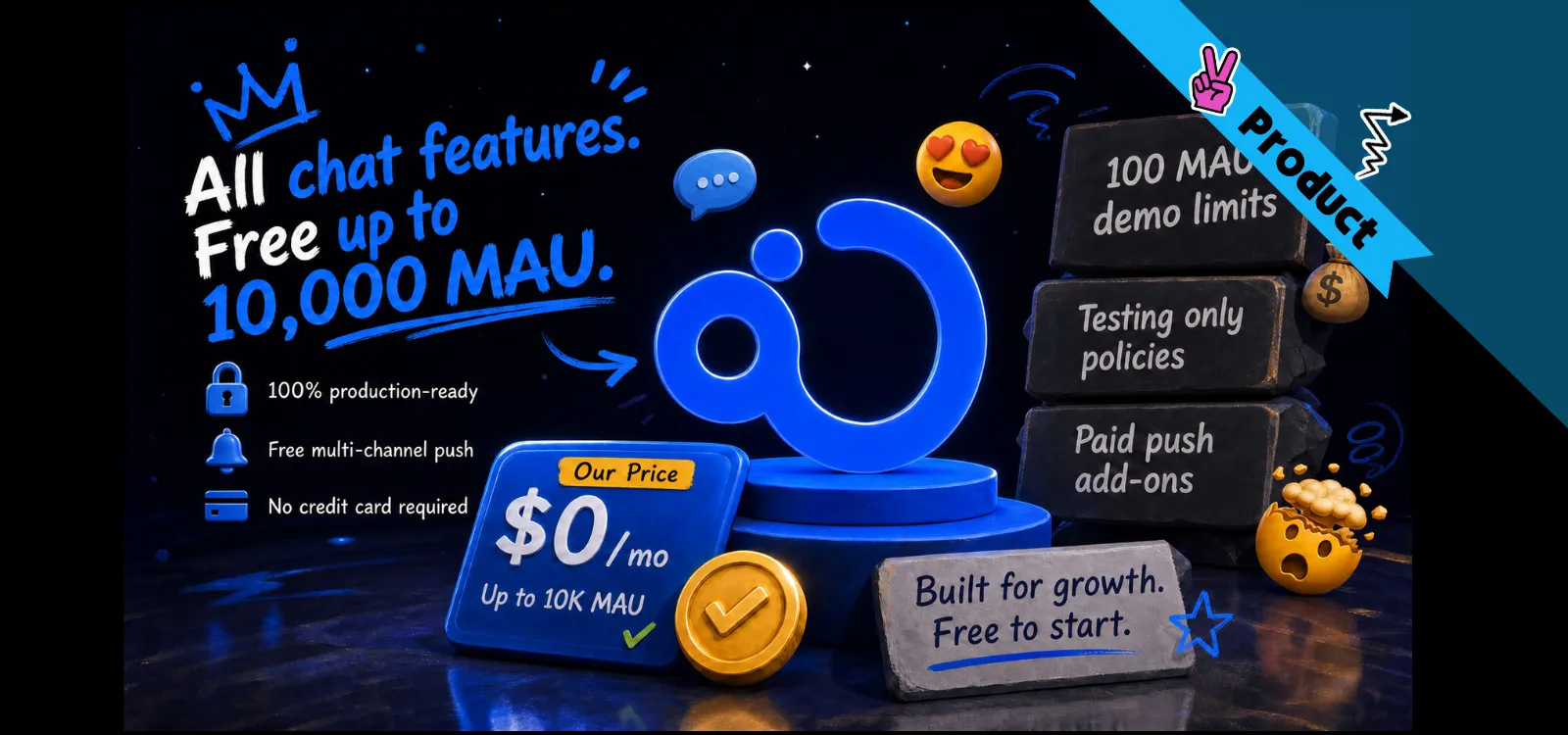
10,000
5% of MAU (500 at 10K)
✓ Multi-channel, no extra cost
Full Pro-Tier Feature Set
✓ Real product launches (PMF)
The pattern across the first four rows: most free tiers in this category are sized and positioned for validation, not for carrying an actual product past its earliest days. That's a reasonable design choice from the vendor's side — but it means the "free" number on the pricing page and the number that matters for planning a real launch are usually two different things.
Assuming a flat $50/month for third-party push notification infrastructure where a vendor doesn't bundle it — a conservative estimate for a small-to-mid volume app — here's what a year of usage costs at five points on a realistic growth curve.
12-Month Cost at Five Growth Stages
Vendor
100 MAU
500 MAU
1,000 MAU
5,000 MAU
10,000 MAU
Sendbird
$600/yr (push only)
~$5,388/yr
~$5,388/yr
~$5,388–7,788/yr
~$6,348–14,988/yr*
CometChat
$600/yr (push only)
~$4,188/yr
~$4,188/yr
~$5,988–8,988/yr
~$11,988–15,588/yr*
Stream
$600/yr (push only)
$600/yr (push only)
$600/yr (push only)
~$5,388–6,588/yr
~$6,588/yr
PubNub
$600/yr (push only)
~$1,776/yr
~$1,776/yr
Variable (transaction)
Variable (transaction)
Tencent RTC Chat
$0
$0
$0
~$4,788–8,388/yr
~$4,788–8,388/yr
Nexconn
$0
$0
$0
$0
$0
*Note: Costs are shown as ranges based on plan tiers (lower end reflects entry-level plans with scaled-back features; upper end reflects full Pro equivalents). In particular, Stream's 10K MAU figure reflects its entry-level Start tier ($499–$549/mo), which excludes Pro-level capabilities such as webhooks, multi-device sync, and advanced moderation.
Add it up across the growth curve and the gap isn't a rounding error. A team growing from 100 to 10,000 MAU over its first year spends somewhere between roughly $6,600 and $16,000 on Sendbird, CometChat, or PubNub depending on growth speed and which tier boundaries get crossed along the way. Even on Stream, which offers the lowest entry-level paid tier, it represents meaningful spend once the free Build tier is exceeded. On Nexconn's offer, that same growth curve costs nothing, because the ceiling it's measured against isn't 1,000 MAU or 2,000 MAU — it's 10,000 MAU.
The Hidden Costs: Concurrency Penalties & Third-Party Push Fees
Every MAU-based vendor in this category also meters concurrent connections, and this is where free-tier comparisons get genuinely misleading if you only look at the MAU column.
Vendor
PCC Overage Rate
Publicly Published?
Sendbird
Reportedly ~$5.00 / connection
No — Not publicly listed on official pricing page; figure traces to community disclosures and competitor analyses.
CometChat
$1.00 / connection
Yes
Stream
$0.99 / connection
Yes
Nexconn
$0.90 / connection
✓ Yes (Fully transparent)
A free tier's concurrent connection allowance only means something relative to how many total users you have. Nexconn's offer includes 5% of MAU as free concurrent capacity — at 10,000 MAU, that's 500 concurrent connections, enough headroom for a genuinely active live feature, a busy group chat, or a traffic spike without immediately triggering overage. Compare that to a free tier advertising an "uncapped" or unusually generous concurrent allowance sitting on top of only 1,000 MAU: even at a high simultaneous-engagement rate, the realistic ceiling on how many people could possibly be online at once is bounded by that same 1,000-person user base. A larger, defined ratio on a much larger user base tends to translate into more usable real-world headroom than an unbounded ratio sitting on a small one — the total addressable concurrency is what matters, not just whether a cap technically exists.
Concurrent connections aren't the only dimension where free-tier comparisons miss the full picture. Push notifications are the next one.
Third-party push notifications are a cost that's easy to overlook during vendor evaluation. A typical small-to-mid volume app can expect to spend roughly $50/month on third-party push infrastructure—and that cost adds up quickly.
Multi-channel push — APNs, FCM, and manufacturer-specific channels like Huawei — is the most common hidden cost. It is either a separate subscription fee or a complex engineering project on almost every provider in this comparison, except Nexconn, where native multi-channel push is bundled at zero additional cost.
Push Provider / Route
Free Tier
Paid Starting Price
Typical Cost at 5K MAU
Typical Cost at 10K MAU
OneSignal
10,000 subscribers
$9/mo (Growth)
~$29/mo
~$49/mo ($588/yr)
Firebase FCM
Unlimited (basic)
$0 (requires custom backend)
$0 + engineering time
$0 + engineering time
Amazon SNS
1M publishes free
$0.50 / 1M messages
~$5/mo
~$10/mo ($120/yr)
Pusher Beams
1,000 devices
$29/mo
~$59/mo
~$99/mo ($1,188/yr)
Nexconn Native Push
Included up to 10K MAU
$0 (Bundled)
$0 (Save ~$350/yr)
$0 (Save up to $1,200/yr)
The True Value of All-Inclusive Push: Setting up push notifications on other platforms means either paying $120 to $1,188 per year in third-party SaaS fees, or sinking weeks of senior engineering time into building APNs token refresh, FCM queues, device mapping, and OEM-specific battery optimization workarounds. Nexconn bundles end-to-end multi-channel push directly into the SDK, eliminating both the extra invoice and the infrastructure headache.
The same pattern shows up with a handful of adjacent needs: SSO/SAML for enterprise customers, audit logging for compliance review, and multi-region deployment options for latency-sensitive or data-residency-sensitive markets. On most vendors in this category, some combination of these sits behind a higher tier, an add-on fee, or a custom quote. On the current Nexconn offer, they're included as part of the same $0 package described above.
None of these individually looks like a large number in isolation. Stacked across a year of operating a real product, they're a meaningful share of what actually shows up on an invoice that a free-tier headline number never mentioned.
The Nexconn Offer: Production-Ready at $0
The number that makes this worth stating plainly: this isn't a stripped-down free plan with a large MAU allowance bolted on. It's the same feature set as Nexconn's Pro plan.
Channels and messaging: Unlimited messages across Direct, Group, Community, and Open Channels. Community Channels that scale with your MAU—supporting up to 10,000 members in the free plan — with sub-channel and member-group management baked in. Open Channels with no cap on how many you run, broadcast support included.
Message capabilities: Metadata, message updates, mentions, read receipts, typing indicators, multi-device sync — the details that separate a finished chat experience from a functional one.
Delivery and automation: Multi-channel push included by default, not configured separately. A complete webhook system for backend automation.
Resources: 10,000 MAU. Peak concurrent connections at 5% of MAU. 25KB message bodies. 10GB storage. 10GB upload capacity. 180 days of message history, extendable to two years for a fee.
Governance: SSO/SAML, fine-grained permissions, audit logging — the controls a real product needs before onboarding real users, not features reserved for a much higher tier.
For context on what that's worth in dollar terms: the equivalent Pro plan at 10,000 MAU is priced at $860/month on Nexconn's standard pricing page. The current offer isn't a discount on a lesser plan — it's the full-price plan at $0 for a defined window.
Exceeding the free limit doesn't force you into a specific paid plan. When you're ready to upgrade, both Starter and Pro are available—you choose what fits your stage.
We'd love to discuss how Nexconn's real-time communication solutions can support your business. Request a demo, explore pricing, or get tailored onboarding guidance.