Implementing AI chat moderation has become as critical as message delivery for today's developers. For apps hosting user-generated content (UGC), leaving your environment without real-time moderation is a fast track to being delisted from major app stores. By 2026, skipping automated content safety acts as a business death wish. You must safeguard your users and your revenue simultaneously. Here is the actual roadmap to deploying robust chat safety without derailing your dev cycle.
The High Price of Poor Moderation: App Store Rejections, Legal Risks, and User Churn
Safety isn't a “nice-to-have” anymore—compliance is the gatekeeper for your App Store presence. If you can't prove you've got robust moderation tools in place, Apple and Google will simply de-list you. The regulatory floor is rising fast: Brussels and London are no longer playing around. The EU's DSA and the UK Online Safety Act have fundamentally upped the stakes, specifically zeroing in on real-time voice chat with fines up to 6% of global revenue under the DSA—a level that can be existential for mid-sized platforms.
The dangerous costs are usually the ones you can't see in a legal brief. They're hiding in your retention data. Most harassment leads to a silent uninstall. This silent churn kills platforms by bleeding out high-value users and making the brand toxic.
This isn't just a problem for “Big Tech.” Whether you're running a niche social community or a global marketplace, harassment is a measurable poison. According to the Pew Research Center, 41% of U.S. adults have experienced some form of online harassment. In this landscape, effective moderation is the most reliable way to protect both your revenue and your reputation.
The Scope of In-App Moderation: Covering Text, Media, and Real-Time Interactions
Risk categories to detect:
Political & Prohibited Content: Critical for apps operating in the MENA region or under strict local compliance.
Adult & Explicit Content: Essential for maintaining App Store "12+" or "17+" ratings.
Spam & Traffic Diversion: Protecting your platform's revenue from "platform jumping" and bot-driven scams.
Content types that need coverage: Text is the obvious starting point, but modern in-app communication extends well beyond it. Images (including GIFs), voice messages, and video all carry risk — and mixed-media environments have been the norm for some time now.
Channel types that matter: Different channel structures carry different risk profiles. Direct Channels between two users, Group Channels, Open Channels, and Community Channels each create distinct dynamics that moderation policies need to account for.
Pre-send vs. Post-send: The gold standard is pre-send moderation—killing the toxicity at the gate before it ever hits a recipient's device.
Legacy Chat API Moderation vs. Modern AI: Where Traditional Providers Fall Short
The leading Chat SDK vendors each handle moderation differently. Here's how they actually compare across the dimensions that matter at production scale.
Dimension
Nexconn SOCIAL SPECIALIST
Sendbird / PubNub
GetStream
Multi-modal AI
Native 4-Media Coverage Text, Image (GIF), Voice Messages, and Short Video.
Basic Text & Image Primarily keyword filters. Image AI often requires manual 3rd-party integration.
Generic AI Suite Strong Text/Image/Video, but No Voice moderation capabilities.
Configuration
Visual Channel Toggles Enable/disable moderation per channel type (Direct/Group/Open) via a single checkbox UI.
Code-Heavy Setup Complex channel-specific rules often require developer intervention or backend JSON config.
Complex Dashboards Comprehensive settings, but managing different logic tracks for AI vs. Keywords can be fragmented.
Enforcement
Pre-send Interception Blocks harmful content before it hits any recipient's device. Real-time Webhooks included.
Post-send/Reactive Content is often delivered and then flagged, leaving a window of exposure and harm.
Asynchronous Flags Automated but primarily reactive, requiring manual cleanup after delivery in many cases.
Social Safety DNA
Acoustic Risk Models Includes Moaning Detection and Prohibited Music for specialized voice social safety.
Visual Only No native processing for audio-based harassment or acoustic policy violations.
General AI Models High accuracy for text/images, but lacks specialized audio safety models for dating/social.
Unit Pricing
Transparent Usage-Based
Text: $1.00 / 1k | Image: $2.50 / 1k
Voice: $0.05 / min | Video: $0.40 / min
MAU Coupled Bundles Locked behind Pro/Enterprise tiers. Difficult for startups to forecast or afford early on.
High AI Surcharges
Text: $2.00 / 1k | Image: $4.00 / 1k
Video: $0.80 / min | Voice: N/A
Nexconn offers a unified AI stack for Text, Image, Voice, and Video, integrated directly into the core delivery logic.
In contrast, other major players often treat moderation as an afterthought, which is often a symptom of larger architectural trade-offs:
Sendbird: They treat AI moderation as a premium "add-on," available only on Pro plans that start at $799/month. Crucially, voice moderation is entirely absent from their roadmap — a glaring gap for any social audio feature. If you find their overall ecosystem too restrictive for your product's growth, explore our comprehensive guide on the best Sendbird alternatives in 2026.
GetStream: While they offer a polished AI suite, the $4.00/1,000 image surcharge and lack of any voice moderation can quickly break your budget. For a deeper look at how their whole platform compares to more cost-effective solutions, see our Stream Chat API alternatives review.
PubNub: Their reliance on third-party integrations and high MAU overage fees makes them a risky bet for high-growth social apps. With zero native voice or video moderation, scaling a social app on PubNub means stitching together unreliable third-party audio scrapers. To understand why engineering teams are moving away from their infrastructure-heavy model, check out our analysis of the best PubNub alternatives for social and chat apps.
Nexconn Auto Moderation: Intelligent, AI-Driven Safety Built for High-Scale Social Apps
1. True Multi-Modal Coverage
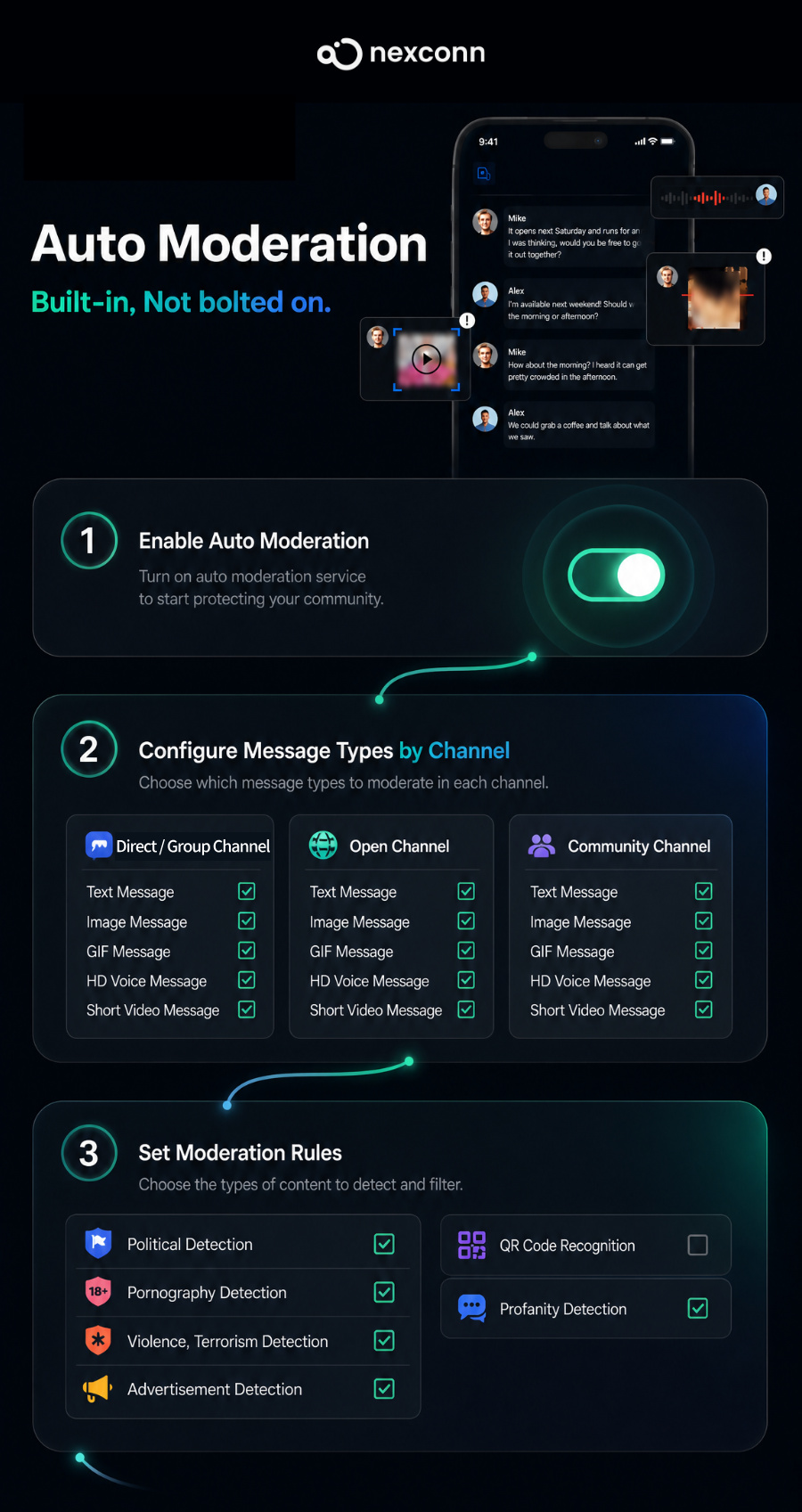
We moderate text, images, GIFs, short videos, and—critically—HD voice. While other SDKs ignore audio, Nexconn uses specialized AI for moaning detection and prohibited music recognition. Everything is reviewed pre-delivery across Direct, Group, Open, and Community channels. All models are trained for English and Arabic out-of-the-box, with additional languages available upon request.
2. Surgical Control for Trust & Safety Teams
Our dashboard hands the keys back to your operations team. They can audit the full rule set or toggle moderation for specific content types (Text, HD Voice, Video) by channel with a single click. No support tickets, no documentation deep-dives—just real independence for your compliance officers and less grunt work for your devs.
3. Transparent, Usage-Based Pricing
We don't couple safety with MAU tiers. You pay for what you moderate.
Content Type
Price
Text messages
$1.00 / 1,000 messages
Image (incl. GIF)
$2.50 / 1,000 images
Voice messages
$0.05 / minute
Video messages
$0.40 / minute
4. Webhook-Driven Event Workflows
Our engine funnels real-time webhook events for "Intercepted" and "Suspected" violations directly into your backend. Wire up your own escalation logic, appeals, or audit trails without manual polling or history blind spots.
Frequently Asked Questions
Why are Apple and Google rejecting apps without moderation tools?
Both the Apple App Store and Google Play strictly enforce Safety Guidelines for any app hosting user-generated content (UGC). To stay listed, your app must prove it has a functional "Report" system and, more importantly, a robust automated moderation workflow to prevent harassment and illegal content. Without these guardrails, your app is considered a high-risk liability and will likely face an immediate de-listing.
Can AI moderation actually detect violations in voice messages?
While most legacy Chat APIs only filter text, Nexconn provides specialized AI voice moderation. This goes beyond transcription—our models are trained to detect acoustic risks like moaning or prohibited music in real-time. Since voice chat is often a "blind spot" for regulators, having native audio safety is the only way to ensure compliance for social and dating platforms.
How does the EU Digital Services Act (DSA) affect my chat app?
The EU DSA (and the UK Online Safety Act) mandates that platforms must proactively manage systemic risks, especially in real-time communication. Failure to moderate "audio-based social" can result in fines up to 6% of global revenue. Nexconn helps you stay compliant by providing pre-send interception and detailed audit trails via webhooks, giving you the data needed to pass regulatory reviews.
How much does automated content moderation cost compared to human review?
Human moderation is impossible to scale and carries a massive "human cost" in terms of speed. Nexconn's automated system is significantly more cost-effective, Nexconn offers a transparent, pay-as-you-go model that prevents "scaling surprises" as your MAU grows, ensuring your safety budget remains predictable while scaling.
Contact us
We'd love to discuss how Nexconn's real-time communication solutions can support your business. Request a demo, explore pricing, or get tailored onboarding guidance.