Scaling Chat for Global Live Events: Managing High-Concurrency Fan Engagement
Amy
Solutions Engineer @Nexconn. Amy empowers teams in Web3, Social, Gaming, and Digital Services to scale through Chat/Call APIs & AI bots. She shares battle-tested playbooks to turn interaction into ROI.
Every few years, a global tournament creates a synchronized pulse across the planet. A last-minute goal or a controversial referee decision triggers an immediate, high-velocity burst of data. Fans flood into digital stadiums—your app's chat rooms—to roar together in real-time. In these moments, your infrastructure faces its ultimate stress test. (We've seen these exact high-concurrency patterns before—check out our 2026 Case Study on Scaling Voice Social in the Middle East to see how this infrastructure holds up under real-world pressure.)
Live video delivery usually takes the headlines, yet the real-time chat engine determines whether a fan stays on your platform or uninstalls in frustration. Chat has graduated to the primary social fabric of the sports experience. This is where the hype lives. Chat turns a static broadcast into something alive—a shared, high-stakes event.
The numbers back this up: 52% of sports fans won't settle for just watching; they demand interaction. To compete today, platforms must deploy a scalable chat API capable of supporting millions of concurrent connections without letting the conversation lag behind the live play.
Engineering the Engagement Funnel: Scaling from Global Open Channel to Private Fan Groups
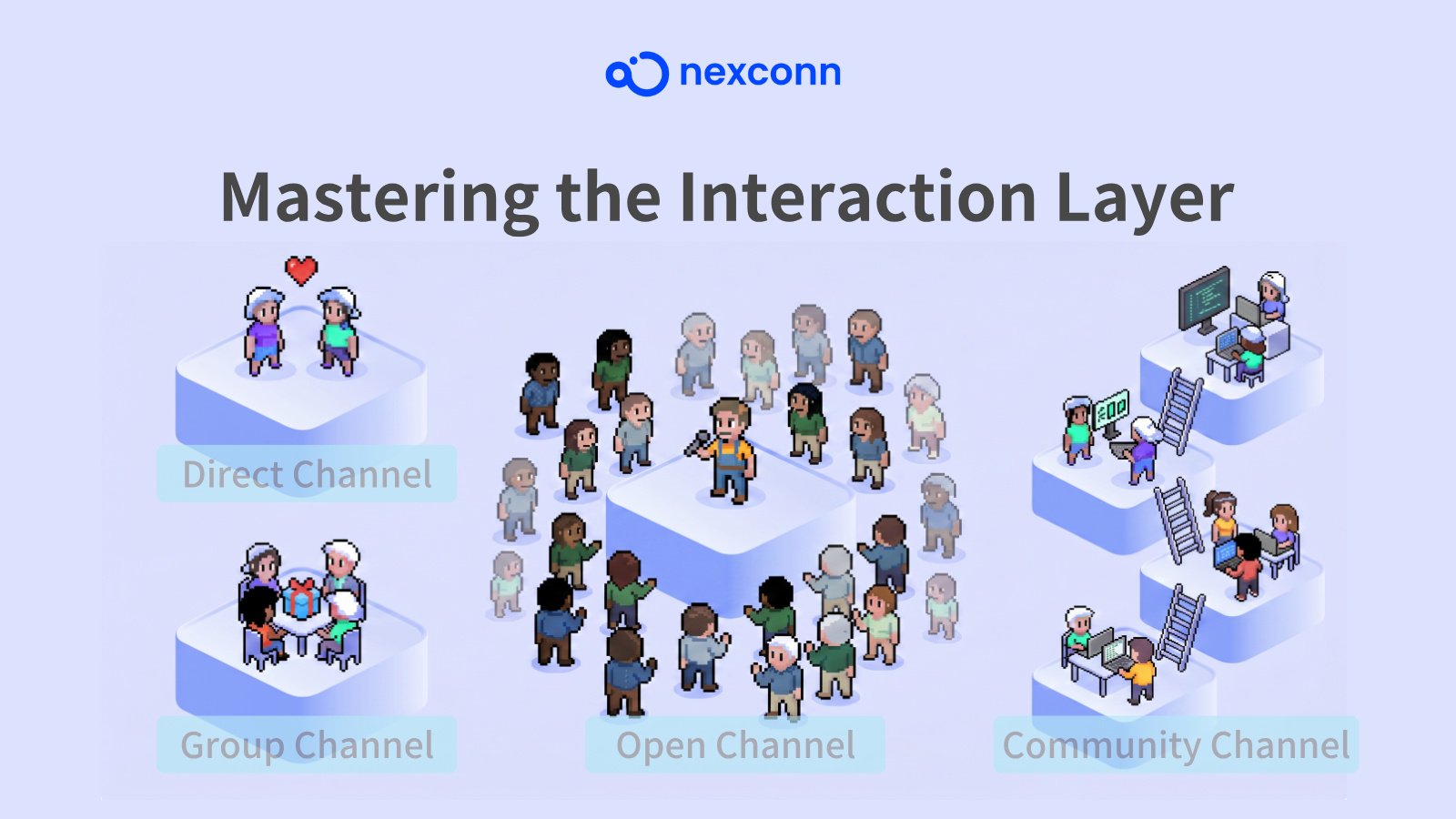
During a major tournament, the fan experience fragments into three parallel conversations. Fan journeys are riddled with technical landmines. Your infrastructure needs enough horsepower to shunt users from a million-person public roar into private circles instantly. Drop the ball during that transition, and your engagement funnel is dead.
1. The Global Stadium: Open Channel
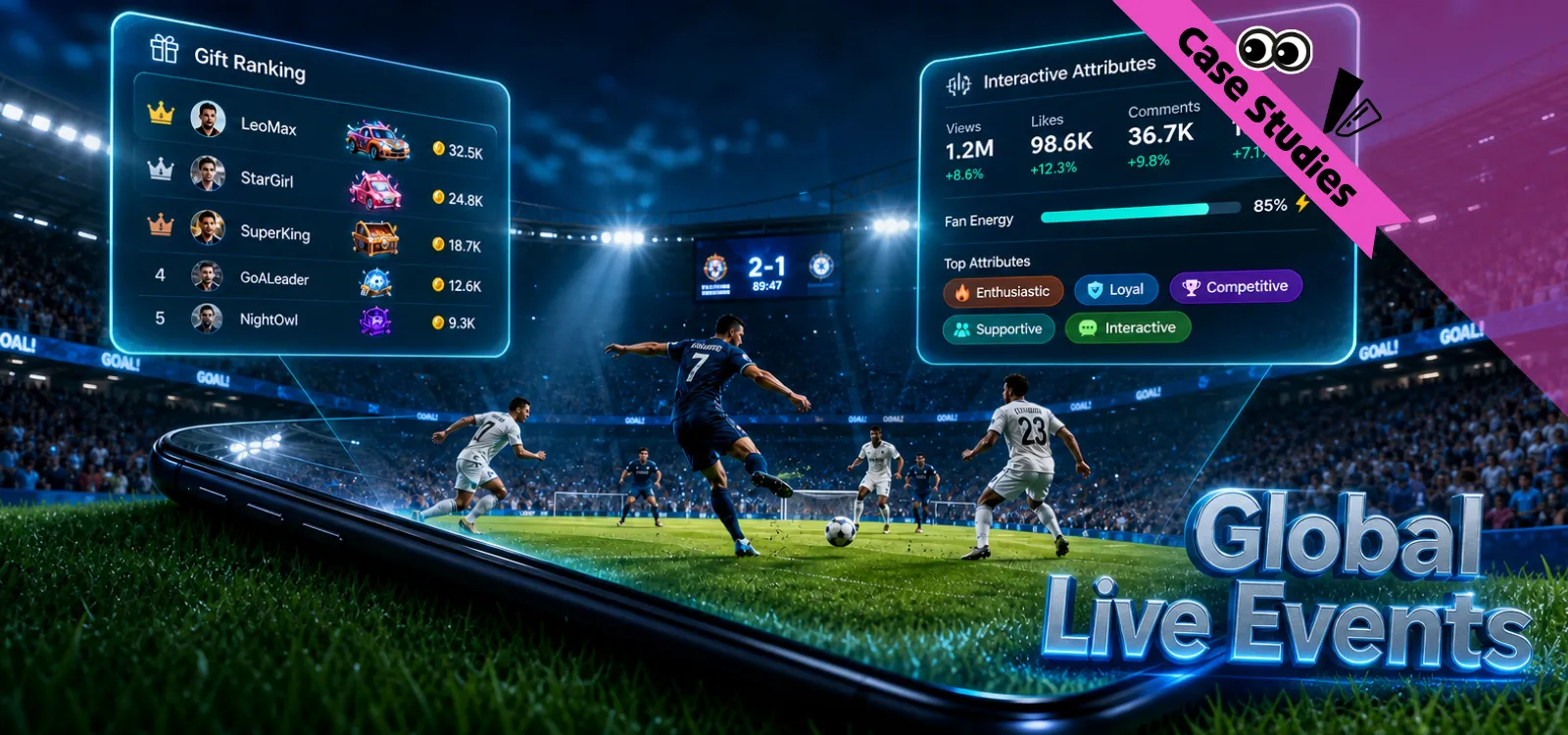
Open Channel powers the mass broadcast surface—the scrolling reaction stream beneath a live match or the community wall where millions interact without prior connection.
The Distribution Challenge: In a channel with a million viewers, one inbound message creates a million outbound deliveries. Naive architectures buckle here. Nexconn utilizes a layered fan-out model, distributing the message load horizontally across dedicated services to maintain stability during peak scoring moments.
Dynamic Room Attributes: Beyond messaging, live sports require real-time state sync. Our attribute system manages leaderboards, gift rankings, and PK scores as key-value pairs. New joiners receive the full state instantly, while active users get only the delta updates, eliminating the need for expensive client-side polling.
Intelligent Message Triage: High-volume traffic can easily exceed client processing power. Nexconn's priority system protects critical content—like moderator announcements or high-value gifts—from being discarded during traffic spikes.
Upstream Moderation: We implement pre-delivery moderation at the ingestion layer. Content violations are blocked before they reach the distribution queue, as post-delivery removal is ineffective at stadium scale.
Maintaining safety at stadium scale demands more than simple filters—it requires high-precision automation. We've mapped out the full architecture behind pre-delivery intercepts and voice safety in our Mastering Real-Time AI Chat Moderation: The 2026 Guide.
2. The Inner Circle: Group Channel
As the public roar continues, fans retreat to more intimate spaces: the watch party with friends, the club-specific thread, or the fantasy league group.
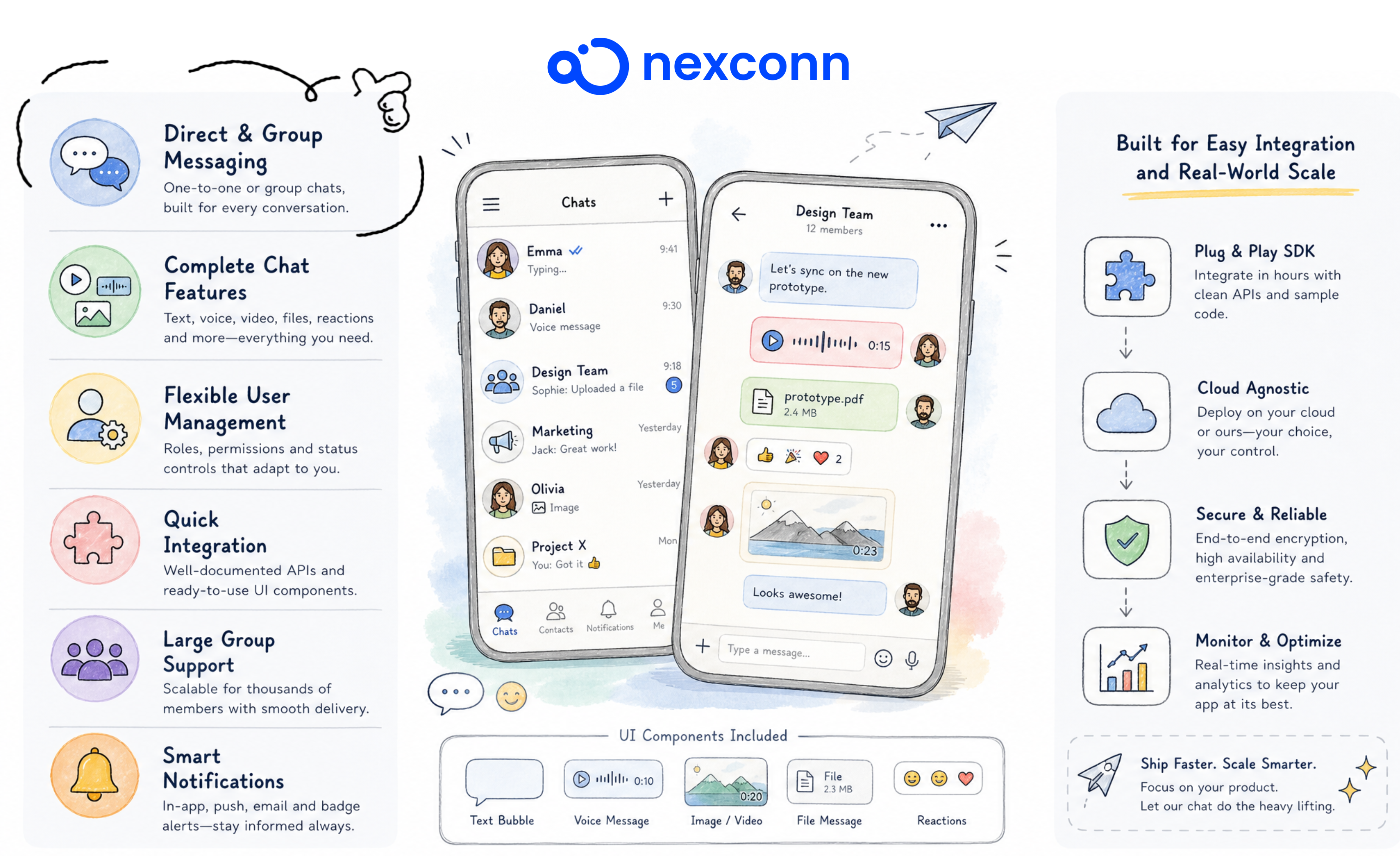
Rich Media & Context: In these circles, the conversation shifts from text to media. Group Channel supports up to 3,000 members with native support for voice notes, video clips, and location sharing. Features like threaded replies and message quoting keep the tactical debates organized.
Uncompromising Reliability: We ensure reliable delivery via server-side acknowledgment queues, coupled with local database persistence on the client to guarantee messages survive network handovers and offline scenarios.
Rapid Deployment via UI Kits: Sports seasons wait for no one. Our UI Kits for iOS, Android, and Web provide pre-built, themeable components—from message threads to input toolbars—allowing teams to ship professional chat interfaces in days.
3. The Direct Line: Direct Channel
The most personal layer activates after the final whistle. Direct Channel handles the 1-to-1 social cleanup: debating the result, sharing highlights, or coordinating the next meetup.
Bilateral Precision: The focus here shifts to sync and accessibility. Our architecture ensures instant history loading and accurate unread counts across all user devices.
Offline Resilience: Direct communication often happens in bursts. We prioritize offline message delivery, ensuring that a fan's "take" on a controversial VAR call is waiting for their friend the moment they reconnect.
Sports-Grade Scalability: Handling Million-User Spikes Without the Lag
Live sports represent one of the few categories of global content that generates genuine, instantaneous traffic spikes. Unlike typical business apps where usage grows in a predictable curve, sports traffic manifests as a step change. When the kickoff whistle blows, millions of connections attempt to establish a session within seconds. When a goal occurs, every user triggers a simultaneous write operation.
ISPs report network traffic surges of up to 200% during major finals. The application layer feels this pressure even more acutely. Handling a "normal" Tuesday load means nothing. The real test is the peak—that split second after a game-winning shot. That's when standard stacks usually hit a cascading failure. In the sports world, if your system chokes under pressure, you've failed your audience exactly when they needed you most.
Nexconn achieves sports-grade scalability through a Burst-First Architecture designed for these specific volatility patterns:
1. Thundering Herd Mitigation at the Edge
The simultaneous joining of millions of users—known in engineering as the "Thundering Herd" problem—can crush a centralized authentication service. Nexconn leverages SD-CAN (Software Defined-Communication Accelerate Network) to handle connection handshakes at the edge. By distributing the connection layer across global PoPs (Points of Presence), we prevent the "Front-Door Jam," ensuring that users enter the chatroom instantly even as the stadium fills up.
2. Deterministic Latency under Billion-Scale Throughput
While video can rely on buffers, chat requires deterministic latency. A "GOAL!" alert arriving late isn't a notification—it's a spoiler. We adopted a proprietary binary-packed protocol over standard JSON-over-WebSocket. Independent benchmarks show that binary serialization can reduce message payload size by up to 30% compared to JSON, enabling our clusters to handle massive fan-out spikes more efficiently. We hold to a sub-120ms delivery cap because, in live sports, speed is the only metric that matters.
3. Intelligent Backpressure & Load Triage
During extreme spikes, the volume of data can exceed what a mobile device can process without lagging the UI. Nexconn implements Server-Side Load Triage. Our message layer categorizes traffic in real-time, prioritizing high-value signals—like score updates, moderator commands, and gift animations—while dynamically rate-limiting lower-priority comments. This ensures the "vibe" remains intact even if the raw volume of chatter hits a physical limit.
Includes 20+ pages of infrastructure insights and growth strategies.
Frequently Asked Questions
1. How does Nexconn handle million-user spikes during a live goal?
We leverage a layered distribution model combined with SD-CAN edge networking. By distributing connection handshakes across our global Points of Presence (PoPs), we eliminate the "Thundering Herd" problem at the central server. This architecture allows our message layer to fan out data horizontally, maintaining stability even when traffic triples in a matter of seconds.
2. Why is sub-120ms latency a requirement for sports applications?
Speed defines the fan experience. A chat message arriving late acts as a "spoiler," leaking a goal before the video stream even catches up. Nexconn maintains the sub-120ms delivery benchmark through our SD-CAN. This global infrastructure utilizes intelligent routing across 3,000+ nodes to identify the fastest possible data path in real-time. By combining edge-side handshakes with optimized server-to-server relay logic, we eliminate the traditional bottlenecks of global internet routing, ensuring fan reactions remain perfectly synchronized with every live moment.
3. What makes Nexconn's Open Channel better than standard chatrooms for big events?
Nexconn's Open Channel architecture removes membership ceilings entirely. Beyond raw messaging, it includes a real-time attribute system to manage room states like gift leaderboards and PK scores. This system pushes state changes to users as key-value pairs, which eliminates the need for expensive client-side polling and significantly reduces device battery drain during long matches.
4. Can chat moderation keep up with stadium-scale message volume?
Manual review is impossible at this scale. We implement pre-delivery AI moderation directly at the ingestion layer. This "intercept" model reviews every message mid-flight, blocking prohibited content before it ever enters the distribution queue. Stopping toxicity at the gate is the only way to protect a million-user community without adding perceptible lag to the conversation.
Contact us
We'd love to discuss how Nexconn's real-time communication solutions can support your business. Request a demo, explore pricing, or get tailored onboarding guidance.