In-Game Chat SDK: Building Scalable Lobbies, World Channels, and Team Chat (2026)
Amy
Solutions Engineer @Nexconn. Amy empowers teams in Web3, Social, Gaming, and Digital Services to scale through Chat/Call APIs & AI bots. She shares battle-tested playbooks to turn interaction into ROI.
Looking to build scalable in-game chat without the pricing trap? Explore our Free In-Game Chat SDK (10K MAU) — full Pro-tier power, broadcast support, and multi-channel push at $0.
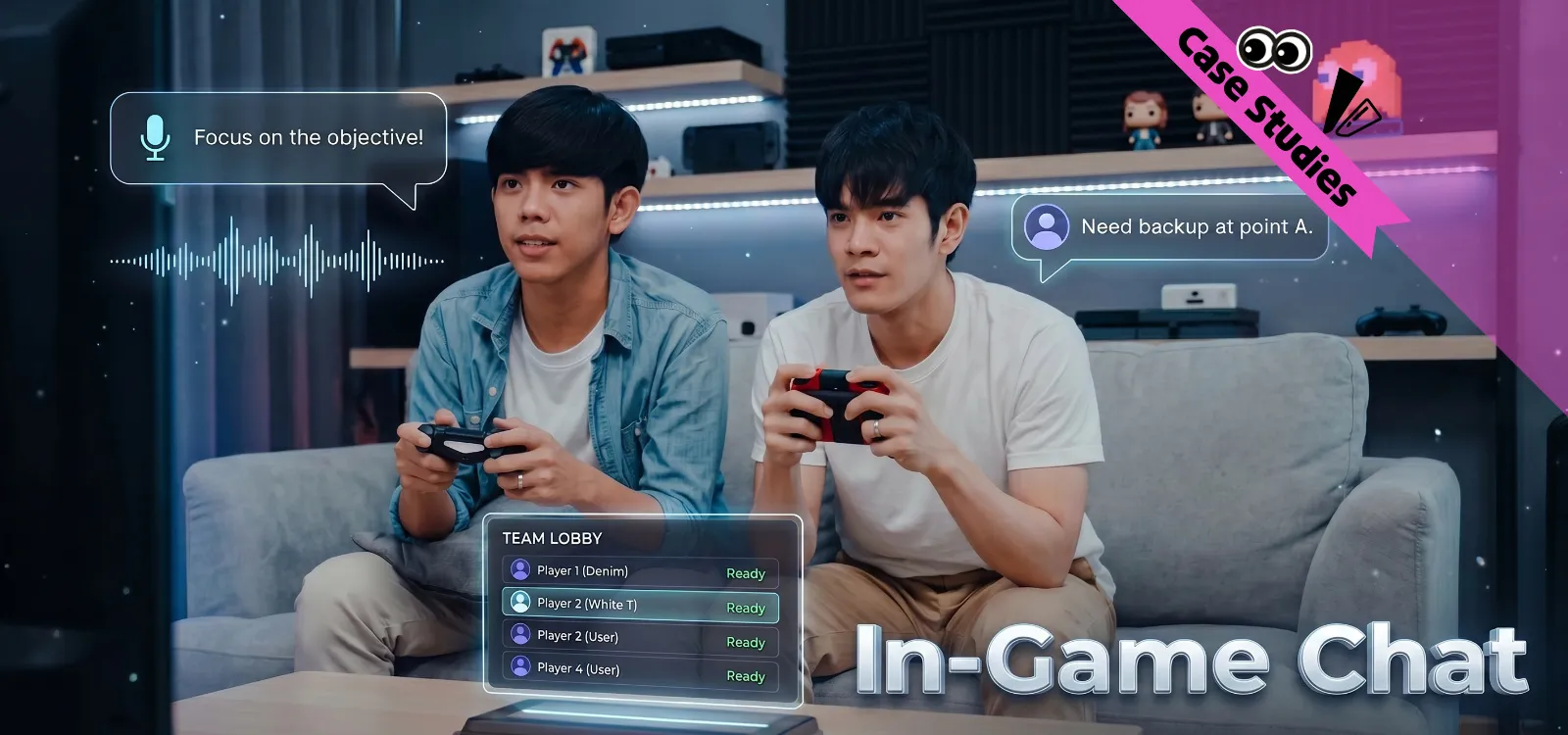
Your in-game chat window is more than a feature; by 2026, it's the frontline defense in the war for player attention. If your messaging stack isn't hardened, your community will inevitably splinter off to external platforms. We're talking about the "glue" of the player experience—if that bond fails, the entire social structure of your game collapses, taking your retention rates with it. Let's be blunt: a polished combat loop only gets you the download. To actually survive the long haul, you need a "Social Moat."
Guilds are a prime example. The logic is straightforward: if grouping up and logging shared victories is friction-free, the game becomes more than a login portal—it becomes a persistent digital home. That's the kind of technical stickiness that keeps the lights on through the inevitable content dry spells.
Why In-Game Chat is the New Social Moat
Gameplay gets players in the door, but social logic keeps them in the room. It works for 1-on-1 calls, too. Shoving a mini-game into the video UI is about nuking that dead air. You're effectively removing the awkward silence that usually makes players bail early. It turns a static conversation into an active session. Suddenly, your chat UI isn't just a simple utility; it becomes a functional gameplay layer where real social bonds are formed.
The data is clear: retention compounds through social cohesion. Players with active in-game ties show a massive jump in 90-day retention because social obligation is a more powerful login trigger than any daily reward. However, to turn "chat" into a "retention engine," the underlying infrastructure must survive specific gaming stress tests that generic messaging pipes simply aren't designed to carry.
Orchestrating the Social Storm: From Lobbies to World Channels
Most generic messaging SDKs feel fine in a 1-on-1 demo but spontaneously combust under actual gaming loads. To build a community that scales, your stack needs to solve four specific engineering hurdles natively:
Smashing the Concurrency Ceiling: Massive events like world-boss spawns or global drops trigger traffic spikes that crush standard messaging pipes. In these high-stakes moments, your world channels can't afford an arbitrary cap. Handling 50,000 players in a single lobby requires a fan-out architecture built to withstand a broadcast storm. If you settle for "best-effort" delivery, you get lag-induced silence right when the game should feel most electric.
State-Aware Metadata: Gaming chat is dynamic. Player roles, guild ranks, and live game states must be baked into the message payload. Relying on external APIs to "retrofit" this data creates desyncs. You need an infrastructure that treats channel attributes as a "ground truth" KV-store, ensuring everyone in the lobby sees the same game state in real-time.
Context-Switching Without Friction: A single session often requires a player to juggle a team voice channel, a persistent guild text thread, and a high-volume live stream chat—all at once. If the user has to jump through hoops to toggle between text and voice, or if the "context" drops during a network handoff, the social loop breaks.
Native Voice-Text Synergy: Bolting on a third-party voice solution to a separate chat SDK is an integration nightmare. True "Social Discovery" in gaming requires a unified engine where the transition from text-based coordination to live voice match-comms is seamless, low-latency, and architecturally consistent.
In-Game Chat SDK Comparison
Dimension
Nexconn
Sendbird
Stream
PubNub
World Channels
Million+ CCU. Optimized for high-frequency gaming broadcast patterns.
High Capacity. Supports millions, but relies on feature-stripping at extreme scale.
Scalable (5M+). General-purpose engine; requires custom logic for game-loops.
Unlimited. Robust Pub/Sub, but lacks gaming-native channel governance.
Network Resilience
QUIC-Optimized. 80% Packet Loss audio recovery via proprietary transport.
Standard TCP/WS. Performance varies in high-jitter mobile environments.
Reliable. Good recovery, but lacks deep QUIC-level transport tuning.
Infrastructure-grade. Global edge, but susceptible to packet loss spikes.
Game State Sync
Native KV Store. 100 updates/sec sync for real-time role/state tracking.
Metadata Support. Designed for user profiles and static channel data.
State Events. Flexible custom events, but requires client-side reconciliation.
Raw Pub/Sub. Highly flexible, but requires developers to build state logic.
Social Primitives
Built-in. Native Social Graph (Friends, Guilds, Blocks) in one SDK.
Feature-Rich. Strong chat features; social graph requires modular add-ons.
Strong UI Kits. Excellent components; social logic requires custom backend.
Modular. Chat SDK available, but requires separate user/social DB.
Why Nexconn is Built for High-Load Gaming Scenarios
The pattern across general-purpose providers is consistent: solid foundations, gaming-specific gaps. Nexconn's chat product is designed around the scenarios that strain generic platforms.
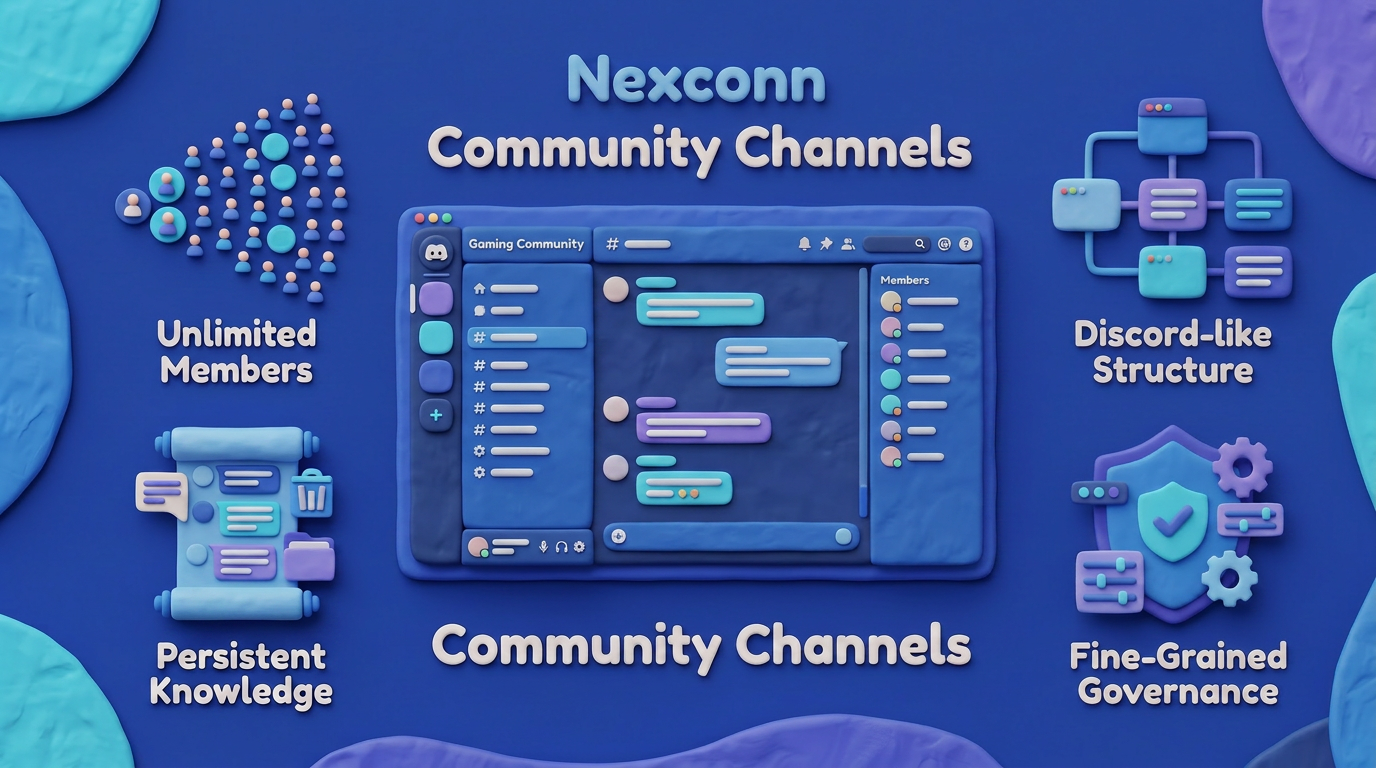
Community Channels Without Member Limits
Nexconn supports community channel features with no member cap. That's an architectural choice that reflects what gaming communities actually look like. A guild with 500 active members, a game-wide announcement channel with tens of thousands of subscribers, a live event room during a seasonal update — these scenarios work without workarounds.
This directly addresses the limitation that surfaces in Sendbird's Supergroup documentation: at scale, generic platforms start disabling features to maintain stability. Nexconn's community channels don't require that tradeoff.
Custom Attributes for Game State
Game logic belongs in game chat. Nexconn supports custom Open Channel metadata — tracking player roles, game status, team assignments — as a native feature. For social games where roles are dynamic (Werewolf being the obvious example, but it applies broadly to any game with in-session state changes), this eliminates an entire class of backend custom work.
The Full Channel Stack in One Integration
Rather than requiring separate integrations for different communication types, Nexconn covers the full range a gaming app needs:
Direct Channels — 1-on-1 and small group conversations with support for text, images, audio, and video. Not a separate SDK.
Audio and video calls — Integrated with smart noise reduction. The same infrastructure that handles team coordination text also handles voice, so context survives the switch from typing to talking.
Live stream chat — Unlimited Open Channels with instant message delivery designed for the broadcast scenario: one-to-many, high volume, low latency. Audience chat during a live stream event doesn't degrade into noticeable delay.
Custom message types — Support for messages tailored to specific gaming scenarios, not just plain text wrapped in game UI.
Grab the 2026 In-App Connectivity Playbook for the full infrastructure roadmap—including delivery optimization for low-bandwidth markets and messaging API best practices.
How do Nexconn's World Channels differ from standard "Supergroups" found in other SDKs?
Traditional Supergroups often impose member caps or are forced to disable real-time features to maintain stability at scale. Nexconn's World Channels are built on a broadcast-grade fan-out architecture specifically designed for massive gaming events. We natively support Million+ Concurrent Users (CCU) without hard ceilings, ensuring that every message is delivered with millisecond latency even during peak traffic spikes like global boss spawns or seasonal launches.
Can I use the SDK to synchronize live game states, such as player roles or scores?
Absolutely. Unlike generic messaging pipes, Nexconn features a Native KV Store (Custom Attributes) that supports up to 100 updates per second per channel. This allows you to bake game-specific metadata—like role assignments in a social deduction game or live capture-the-flag scores—directly into the channel state. This ensures a "single source of truth" for all players in the lobby, eliminating the desyncs and lag typically caused by calling external game-server APIs.
How does Nexconn maintain connection stability in regions with poor network infrastructure?
We utilize a proprietary transport layer built on the QUIC protocol, which is engineered for extreme network resilience. Our stack can recover clear audio even at 80% packet loss and ensures text messages reach the user in high-jitter environments or 4G "dead zones." This makes Nexconn the reliable choice for global titles scaling in high-growth, low-bandwidth markets across Southeast Asia, Latin America, and the Middle East.
Do I need to build a separate backend to manage social features like friend lists and blocking?
No. While infrastructure-only providers require you to maintain your own social database, Nexconn provides built-in Social Primitives. Core social logic—including friend management, user blocking, guild roles, and multilingual content moderation—is integrated natively into the SDK. This "all-in-one" approach allows your team to focus on gameplay rather than building and scaling a custom social backend from scratch.
Nexconn provides real-time communication infrastructure for social, gaming, and marketplace applications, with SDKs for iOS, Android, and web. The platform covers in-app chat, voice and video calls, and gaming-specific primitives in a single integration.
Contact us
We'd love to discuss how Nexconn's real-time communication solutions can support your business. Request a demo, explore pricing, or get tailored onboarding guidance.