2026 MENA Data Residency Guide: Saudi PDPL and UAE Compliance
Kai
AI Product Manager.
Building the future of intelligent communication at Nexconn. Focused on integrating AI into messaging, voice, and video to transform how we connect.
Deploy privacy-compliant in-app chat across Saudi Arabia and the UAE with our Free Chat SDK for the MENA Region (10K MAU) at zero cost.
Data residency in the Middle East has shed its status as a back-burner compliance task. With Saudi Arabia's Personal Data Protection Law (PDPL) having been fully enforceable since 14 September 2024, engineering teams can no longer treat where data sits as an elective requirement. By 2026, the single, global-only cloud model is no longer viable for the Gulf.
We've mapped out this blueprint to cut through the MENA regulatory noise, detailing the specific infrastructure logic you need to nail these high-stakes data sovereignty standards.
The Multi-Speed Regulatory Map: Saudi Arabia vs. UAE
Dimension
Saudi Arabia (KSA)
United Arab Emirates (UAE)
Key Authority
SDAIA (Saudi Data & AI Authority)
UAE Data Office (Federal); DIFC / ADGM (Free Zones)
Enforcement Status
Full Enforcement Active (since Sept 14, 2024). Active enforcement phase with 48 decisions issued to date.
Federal PDPL deadline extended to Jan 1, 2027. Cybercrime & Free Zone laws are Active.
Recent Activity
Formal decisions issued against violators focus on legal basis and technical safeguards.
159 companies fined by TDRA for SMS marketing violations; mature DIFC/ADGM audits.
Data Residency
Strict localization; cross-border transfer allowed only under equivalent protection conditions.
Strategic localization required for high-risk sectors; broad enforcement expected by 2027.
Max Penalties
Up to SAR 5M (~$1.3M USD); doubled for repeats; potential imprisonment.
Federal: To be confirmed (up to AED 5M expected); DIFC: Up to $50,000 per violation; ADGM: Up to $28M USD; Cybercrime: AED 500k + detention.
Beyond the UAE and Saudi Arabia, markets like Egypt (Law No. 151) and Qatar (Law No. 13) are rapidly tightening their data oversight. However, our analysis shows that the MENA region is a "multi-speed" environment. The technical infrastructure required for the Gulf markets—currently the most stringent in the region—typically serves as a future-proof blueprint for the rest.
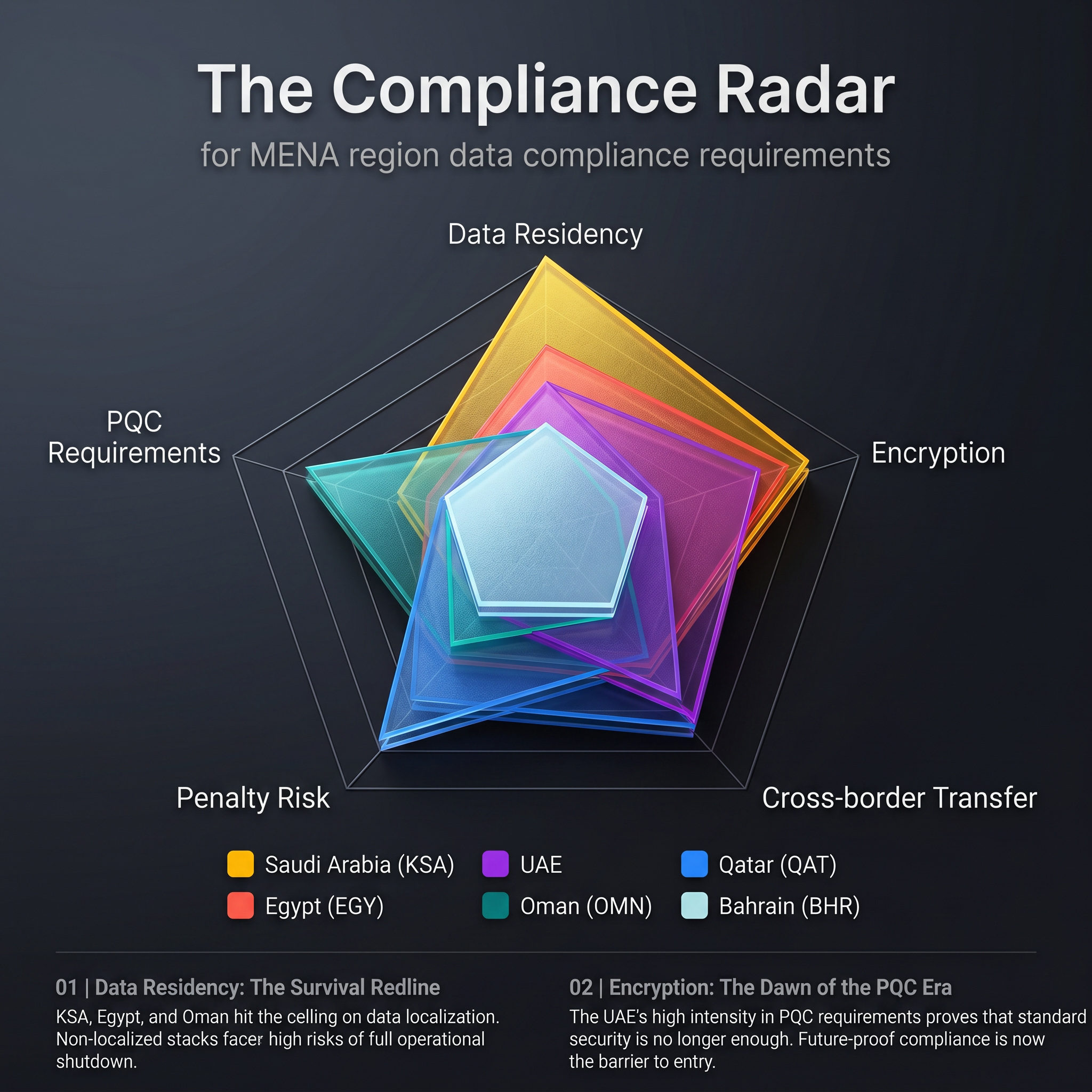
As visualized in our Compliance Radar below, Data Residency has become the absolute "Redline" for KSA, Egypt, and Oman. In these territories, non-localized stacks face high operational risks. By architecting for these high-water mark requirements, global platforms can ensure a consistent security posture across the entire Middle East.
Technical Breakdown: Implementing Compliance in KSA and the UAE
While our comparison matrix covers the high-level risks, implementing Middle East compliance requires a deeper look into the specific operational mandates of each jurisdiction.
Saudi Arabia: The "Prescriptive" Gold Standard
In the Kingdom, compliance is an architectural directive:
Localized Default: Following the September 2024 updates, personal data must stay within the Kingdom by default. For most apps, keeping Saudi user data in-country is the only straightforward path.
Functional Deletion Pipelines: The "Right to be Forgotten" is an engineering task, not just a policy. Deletion requests must trigger an atomic scrub across primary shards and all backup environments.
Hardened Audit Trails: You are legally required to maintain an immutable record of data processing activities for a minimum of five years to survive a SDAIA audit.
NCA & DGA Governance: Platforms serving critical sectors must align with NCA security standards, including localized encryption and mandatory scanning by locally certified vendors.
The UAE’s Regulatory Environment
The 2027 Federal Horizon: For mainland entities, the Federal PDPL is the future standard. With the full enforcement deadline now expected on January 1, 2027, platforms have a strategic window to move toward regionalized data architectures.
The Immediate Threat: Cybercrime Law (No. 34 of 2021): Developers often forget that while the PDPL is "pending," the Cybercrime Law is aggressive. Article 44 (Privacy) targets unauthorized data processing with fines reaching AED 500,000, while Article 6 (Illegal Access) can trigger prison terms for data misuse.
Architecting for Sovereignty: How Nexconn Ensures Middle East Data Residency
Instead of treating compliance as a reactive legal task, Nexconn provides a sovereign-ready infrastructure that handles the heavy lifting at the engineering layer.
Localized Infrastructure & Data Residency
Regional Data Anchoring: Nexconn operates local data centers within Saudi Arabia and the UAE. This effectively bypasses the headache of "adequacy decisions" or complex SCCs by ensuring data never leaves the region.
Transit-Only Routing: During global path optimization, Nexconn's architecture ensures user data never persists at intermediate nodes. The international routing layer remains a "dumb pipe"—transit only, zero storage.
"Compliance-as-Code": Built-in Operational Tools
Instead of manual implementation, our infrastructure bakes PDPL and UAE requirements directly into the SDK:
Functional Erasure Pipeline: We implement the "Right to be Forgotten" as an atomic operation. When a user requests deletion, our system automatically scrubs all associated data across primary databases and backups.
Audit-Ready Logging: Native five-year retention of data processing records, satisfying the PDPL's strict mandates without extra backend work.
NCA-Hardened Security Stack: Our Saudi deployments utilize locally registered domains and encryption standards that align with National Cybersecurity Authority (NCA) requirements.
Zero-Trust Message Integrity
Beyond infrastructure, we enforce privacy at the message level—a critical requirement as MENA regulators scrutinize high-growth communication platforms:
X3DH & Double Ratchet E2EE: Nexconn's end-to-end encryption ensures that even our own servers remain "blind" to message content. This provides a cryptographically verifiable guarantee of privacy that satisfies even the most stringent zero-trust audits.For a comprehensive look at the Signal Protocol architecture Nexconn uses, explore our deep dive into End-to-End Encryption in Chat Apps.
Data Minimization Tools: With native support for disappearing and time-limited messages, platforms can shrink their "risk footprint" by automatically purging sensitive data from both ends of the conversation.
Edge Encryption: All local message databases are encrypted at rest on the user's device, shielding history from physical compromise or unauthorized application access.
📂
Navigating data residency is just one piece of the global expansion puzzle. Download The In-App Connectivity Playbook 2026, providing a complete technical blueprint for managing global chat architecture, latency optimization in low-bandwidth markets, and sovereign-ready security stacks.
Beyond Legal Compliance: Mastering RTL Interface Design and Arabic Cultural UX
Meeting the legal baseline is just the beginning; winning the Gulf market requires a technical architecture that respects the unique digital habits of its users.
Structural RTL Mirroring: Arabic support is a layout challenge, not a translation task. Nexconn automates the full UI inversion—mirroring icons, aligning navigation paths, and localizing numeral formats. Meeting legal requirements is the floor; cultural fit is the ceiling. Native RTL (Right-to-Left) mirroring prevents the "uncanny valley" effect of Western-centric UI shells that native speakers find jarring.
Deep-Linked Push Architecture: Users expect a notification to land them on a specific message. We execute this via independent Push Processes, bypassing the database contention bugs that usually cause app freezes during notification surges.
Carrier-Grade Calling: Nexconn mirrors the carrier experience by hooking natively into iOS CallKit and Android Telecom. Calls hit the lock screen directly—matching the premium, high-fidelity feel that MENA users expect as their daily baseline.
Timing is cultural. Nexconn lets you sync notifications with the local pulse—respecting prayer windows from Fajr to Isha and the massive activity spikes during Ramadan. Interrupting a sacred moment is a quick way to kill user trust.
The 2026 Technical Checklist: Ensuring Regulatory Readiness in the Gulf Market
For development teams preparing to launch or currently operating in Saudi Arabia and the UAE, the compliance requirements map to a concrete set of technical and operational tasks:
What are the core rules for data residency in KSA and UAE?
In KSA, personal data must stay in the Kingdom by default, with cross-border transfers only allowed under strict "equivalent protection" conditions. Nexconn operates local data centers in Saudi Arabia to meet this requirement.
The UAE takes a three-tier approach: Federal PDPL compliance is required by January 1, 2027, while DIFC and ADGM frameworks are already active and independently enforced. The Cybercrime Law (No. 34 of 2021) is also active, with fines up to AED 500,000 for privacy violations.
Can foreign companies be fined for Saudi PDPL violations?
Yes. The SDAIA enforces the PDPL on any organization processing the personal data of individuals located in Saudi Arabia, regardless of where the company is headquartered. With 48 formal enforcement decisions already issued — and administrative fines up to SAR 5 million (doubled for repeat violations), plus potential imprisonment for serious breaches — technical compliance is a prerequisite for market access. Nexconn's infrastructure is aligned with NCA security standards, providing the hardened security stack and mandatory data processing records required to survive a regulatory audit.
How does Nexconn handle End-to-End Encryption (E2EE) and content moderation?
Nexconn uses client-side moderation, scanning content before it is encrypted on the device. This is achieved through pre‑messaging callbacks and client‑side listeners, which allow your app to enforce content policies without decrypting the end‑to‑end encrypted link. This balances MENA safety standards with true user privacy.
Why is RTL automation essential for the Saudi and UAE markets?
Serving Arabic speakers requires more than simple translation; it requires a complete structural UI inversion. Nexconn's SDK automates RTL (Right-to-Left) mirroring, including icon flipping, navigation path adjustment, and numeral localization. Combined with the ability to schedule notifications around regional practices, this delivers a native-feeling experience that builds user trust and retention.
Contact us
We'd love to discuss how Nexconn's real-time communication solutions can support your business. Request a demo, explore pricing, or get tailored onboarding guidance.