The 2026 SEA Compliance Blueprint: Architecting Chat & Social Infrastructure
Kai
AI Product Manager.
Building the future of intelligent communication at Nexconn. Focused on integrating AI into messaging, voice, and video to transform how we connect.
For engineering teams building PDPA-compliant apps across Southeast Asia, our Free In-App Chat SDK for Southeast Asia (10K MAU) provides enterprise data governance, audit logging, and native multi-channel push at zero cost.
Southeast Asia's data privacy landscape just became materially more complex — and the timing is not forgiving.
Vietnam's Personal Data Protection Law (PDP Law) took full legal effect on January 1, 2026, upgrading from a government decree to a national statute with substantially stricter penalties. Indonesia's Personal Data Protection Law (PDP Law) transition period expired in October 2024, with a dedicated enforcement authority—the Data Protection Authority (DPA)—now being stood up in 2026. Malaysia completed its Personal Data Protection Act (PDPA) overhaul in three phases through June 2025, introducing mandatory Data Protection Officers (DPOs), breach notification timelines, and fines that increased more than threefold. Thailand and the Philippines have mature frameworks actively generating enforcement decisions. Singapore continues to tighten its Personal Data Protection Act (PDPA) with sector-specific codes and guidelines.
For engineering teams building chat, social, and other digital services apps for Southeast Asian markets, this is no longer a "we'll handle compliance later" situation. The region's regulators have moved from framework-building to active enforcement — and the specific requirements for communication platforms differ meaningfully by jurisdiction.
This guide maps the technical obligations by country, identifies the highest-risk requirements for chat infrastructure specifically, and explains how Nexconn's architecture handles the compliance layer so teams can focus on product rather than regulatory plumbing.
The SEA Compliance Landscape: A Multi-Speed Environment
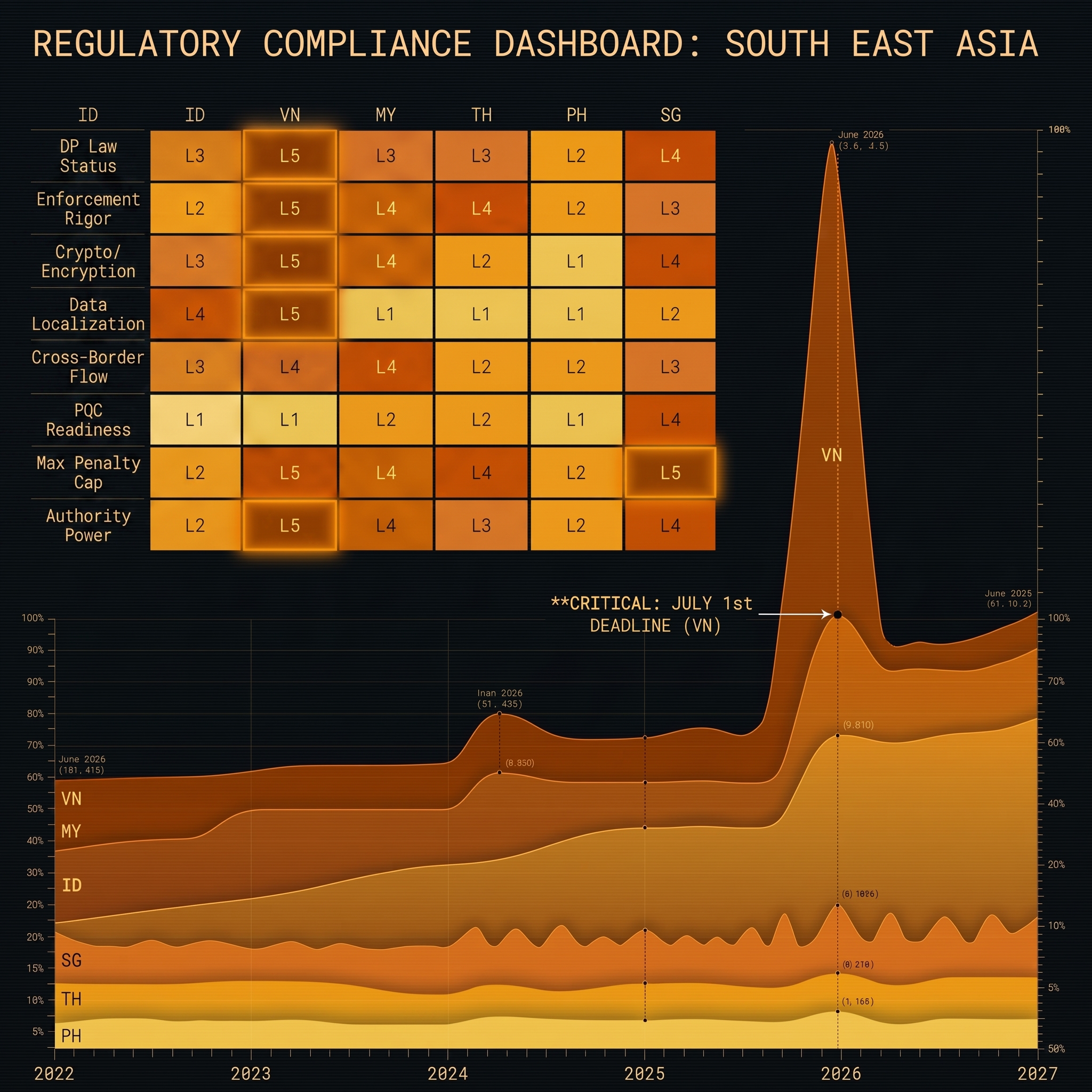
The dashboard below summarizes the compliance posture across six key markets:
Vietnam: Navigating Rigorous Enforcement in 2026
Vietnam's Law on Personal Data Protection (Law No. 91/2025/QH15) is now fully effective. Enforcement is led by the Ministry of Public Security (MPS), specifically the Department of Cybersecurity and High-Tech Crime Prevention (A05), which is currently conducting formal compliance audits across the digital sector.
Data Localization: The Cybersecurity Law mandates that platforms serving Vietnamese users must store data locally. This is not merely a configuration preference but a prerequisite for market entry.
Consent & DPIA: Consent must be explicit, voluntary, and documented. High-risk processing—standard for communication platforms—requires a formal Data Protection Impact Assessment (DPIA), which must be reviewed and updated every six months.
Deletion & Breach Notification: Erasure requests must be atomic, scrubbing data across primary stores, backups, and caches to satisfy MPS requirements. Breach notification is mandatory under Decree 356 with strict, predefined timelines.
Security Standards: Effective data protection necessitates an encryption stack that aligns with mandatory state security standards for protecting user-generated content, applied natively to all data at rest and in transit.
Penalty Reality: The 10x revenue multiplier for data-trading violations is a binding liability applied per violation.
Vietnam represents the highest-risk jurisdiction in the region. The combination of strict localization, harsh penalty structures, and a government authority (A05) that has demonstrated a proactive willingness to audit makes Vietnam the jurisdiction requiring the most urgent technical response.
Indonesia: Full Enforcement, Authority Still Being Built
The PDP Law is fully in force, and the Indonesian Data Protection Authority (DPA) is finalizing its operational framework for 2026. This transition period is the critical window for engineering teams to harden their architecture before the DPA begins active, large-scale auditing.
Criminal Liability: Unlike most regional frameworks, Indonesia’s law includes significant criminal provisions. Beyond administrative fines (up to 2% of annual revenue), violations can trigger asset confiscation or business dissolution, making robust infrastructure-level security a vital legal safeguard.
Data Subject Pipelines: You are required to respond to access, correction, and erasure requests within 72 hours.
Sector-Specific Localization: While not a blanket mandate for all apps, critical sectors (Finance, Health, Infrastructure) face strict residency requirements.
DPO & Notification: Organizations processing sensitive data at scale must appoint a Data Protection Officer (DPO). Breach notification is mandatory once the DPA is fully operational; our infrastructure provides the logs and automated triggers to satisfy these reporting obligations.
The enforcement climate in Indonesia is expected to shift rapidly once the DPA becomes fully operational in 2026. Given the criminal provisions, engineering teams should view these architectural requirements as a mandatory risk-mitigation strategy rather than a static checkbox.
Malaysia: Fully Active, Active Enforcement Already Underway
The 2024 PDPA amendments concluded in June 2025, and the Personal Data Protection Commissioner (PDPC) has shifted to an aggressive enforcement stance, regularly publishing lists of penalized organizations.
Adequacy Assessments: Section 129 requires a risk-based, documented approach to cross-border transfers. Organizations must provide defensible adequacy assessments for any data routing outside of Malaysia.
Data Portability: Platforms are now required to fulfill data portability requests, enabling users to move message history, contact lists, and preferences. This requires a programmatic export pipeline to satisfy the legal right to portability.
Breach Notification & DPO: Mandatory notification within 72 hours is in force. Organizations must appoint at least one Data Protection Officer (DPO) to oversee compliance and manage regulatory reporting duties.
Biometric & Sensitive Data: Processing biometric data now requires explicit consent. Platforms must ensure that user-generated content and associated identifiers are handled with heightened security measures.
With fines increased to RM 1 million and extended custodial sentences, non-compliance for communication platforms is now a board-level operational risk. The regulator has moved past the framework-building phase, and documented, proactive compliance is now the baseline expectation.
Thailand: Stable and Actively Enforced
Thailand's PDPA has been in full effect since June 2022 and the Office of the Personal Data Protection Committee (PDPC) has been issuing enforcement decisions. The framework is GDPR-influenced, with consent requirements, purpose limitation, data subject rights, and cross-border transfer controls.
For chat platforms, Thailand's key requirements are:
Consent-based processing: Explicit consent required for sensitive data categories. Chat history, location data shared in messages, and health information shared via chat all qualify as sensitive in relevant contexts.
Cross-border transfers: Standard contractual clauses or adequacy decisions required for routing Thai user data abroad.
Breach notification: 72-hour notification to the PDPC, with notification to affected individuals "without undue delay."
Penalties: Administrative fines up to THB 5 million (~USD 135,000); criminal sanctions for intentional violations.
Thailand's enforcement posture (L4 in the compliance dashboard) reflects a regulator that has moved beyond framework-building into active enforcement. The approach tends toward supervision and remediation rather than punitive fines, but that posture can shift as the PDPC builds institutional capacity.
Philippines: Mature Framework, Active NPC
The Philippines' Data Privacy Act of 2012 is the oldest comprehensive data protection law in ASEAN. The National Privacy Commission (NPC) has been operational since 2016 and has issued numerous enforcement decisions, making it one of the more experienced enforcement bodies in the region.
For communication platforms:
Registration: Organizations processing personal data above defined thresholds must register with the NPC. Chat platforms serving Philippine users at scale likely meet the threshold.
Privacy Impact Assessments: Required for high-risk processing operations.
Breach notification: 72-hour notification to the NPC, with notification to affected individuals.
Data subject rights: Access, rectification, erasure, data portability, and the right to object to automated processing.
The Philippines recently issued guidelines on the applicability of the DPA to AI, requiring transparency when using personal data for AI development or deployment. For platforms using AI-powered features — chatbots, smart replies, content moderation — this creates additional disclosure obligations.
While current administrative fines are capped at PHP 5 million, the NPC is currently pursuing legislative reforms to significantly increase both financial penalties and custodial sentences. Engineering teams should treat compliance as a high-priority risk-mitigation strategy.
Singapore: Mature, Proactive, and Rising
Singapore's PDPA framework is the most mature in the region. The Personal Data Protection Commission (PDPC) issues detailed advisory guidelines, sector-specific guidelines and codes of practice, and enforcement decisions at a level of granularity that sets a regional standard.
Key obligations relevant to chat platforms:
Legitimate interests framework: Singapore allows processing under legitimate interests without consent in defined circumstances — a more flexible regime than pure consent-based frameworks, but with accountability requirements attached.
Breach notification: Mandatory for breaches affecting 500 or more individuals, or involving sensitive data — to both the PDPC and affected individuals within 3 days.
Data Protection by Design: The PDPC has issued formal guidance on DPbD requirements. Encryption, access controls, and data minimization are not just good practice — they are expected by the regulator as baseline implementation.
Maximum penalty: SGD 1 million (approximately USD 750,000), or 10% of annual Singapore turnover — whichever is higher — for organizations with annual turnover above SGD 10 million.
Singapore also issued an Code of Practice for Online Safety (CPOS) in early 2025, imposing age assurance, content moderation, and user reporting obligations on designated platforms. Communication platforms serving Singapore users should review whether they meet the "designated" threshold.
The Cross-Cutting Technical Requirements
Across all six markets, five technical requirements appear consistently — in different forms and with different enforcement weights, but structurally the same:
1. Encryption in transit and at rest
Every framework in the region requires "reasonable" or "appropriate" technical security measures. For communication platforms, the baseline expectation from regulators across ASEAN has converged on TLS 1.3 for transit and AES-256 (or equivalent) for storage. Vietnam adds state encryption oversight; Singapore's PDPC expects security-by-design documentation.
End-to-end encryption is the highest bar — it satisfies all regional standards simultaneously because it makes even Nexconn's own servers blind to message content. This is the cleanest architecture for operating across multiple jurisdictions with different access requirements.
2. Data subject request pipelines
All six frameworks require the ability to respond to access, rectification, and erasure requests within defined timeframes. For chat platforms, erasure is technically complex: a deleted message potentially exists in sender history, recipient history, server storage, backup systems, and content moderation logs. A compliant erasure pipeline must reach all of these simultaneously.
3. Breach notification infrastructure
Vietnam, Indonesia (imminently), Malaysia, Thailand, Philippines, and Singapore all mandate breach notification within 72 hours to the relevant authority. For a chat platform experiencing a data breach at 3am Friday, having a manual process to draft and submit a regulatory notification within 72 hours is not viable. This needs to be built into the platform's incident response architecture.
4. Cross-border transfer documentation
Only Vietnam and Indonesia have explicit data localization requirements for general communication platforms. But every framework requires documented transfer mechanisms for data leaving the jurisdiction — adequacy assessments, contractual clauses, or binding corporate rules. Using a global chat API without documented transfer mechanisms means the platform operator assumes the compliance liability, not the vendor.
5. Consent architecture
All six frameworks require explicit, documented consent for data collection and processing. For chat platforms, this means the signup flow, the terms of service, and the privacy notice all need to be architecturally integrated — not bolted on. Consent must be granular (per purpose), revocable, and the revocation must trigger downstream data handling changes.
How Nexconn Handles the SEA Compliance Layer
Rather than requiring engineering teams to build compliance infrastructure from scratch, Nexconn bakes the core requirements into the SDK and infrastructure layer.
Regional data infrastructure
Nexconn operates data infrastructure across Southeast Asia. This is a meaningful distinction from global chat APIs that route all traffic through US-East or EU-West. The latency impact of correct regional routing is also measurable: keeping traffic within Southeast Asia reduces round-trip times to under 120ms for most markets.
End-to-end encryption: X3DH + Double Ratchet
Nexconn implements end-to-end encryption using the X3DH (Extended Triple Diffie-Hellman) key agreement protocol and the Double Ratchet algorithm — the same cryptographic architecture used by Signal and WhatsApp. This provides:
Forward secrecy: Compromise of current keys does not expose past messages
Break-in recovery: Compromise of current keys does not expose future messages
Verification resistance: Even Nexconn's servers cannot read message content
Functional erasure pipeline
Nexconn implements the right to erasure as an atomic operation across the full message chain. When a deletion request is processed:
Primary message stores are scrubbed
Backup environments are updated
Recipient-side message copies are handled according to the platform's configured policy
Audit-ready logging with configurable retention
Nexconn's infrastructure provides operational logging capabilities that can be configured to support audit trail requirements. Developers retain control over log retention policies in accordance with applicable data protection laws.
Consent management SDK
Nexconn's SDK is designed to be integrated into consent flows that developers implement in their application layer. The SDK supports per-purpose, revocable consent architectures and provides logging hooks that developers can use to timestamp consent events.
Ready to scale your chat and social experience across borders? We've compiled our latest infrastructure blueprints, benchmarks, and multi-region deployment strategies into a comprehensive technical playbook.
Includes 20+ pages of infrastructure insights and growth strategies.
The Strategic Decision: Build Compliance In Now or Retrofit Later
The pattern across Southeast Asia is consistent: frameworks are enacted, transitional periods run out, enforcement authorities stand up, and enforcement begins.
Teams that treat data compliance as a pre-launch checkbox typically discover two problems. First, the technical debt of retrofitting compliant data flows into a system not designed for them is significant — often larger than the original integration work. Second, regulators increasingly look at whether compliance was built in by design or added reactively. The distinction matters when enforcement discretion is being exercised.
The Southeast Asian market opportunity is substantial: the region's digital economy continues outpacing global benchmarks, with social and communication apps driving a disproportionate share of engagement and revenue. Winning that opportunity while managing the compliance environment requires infrastructure that handles the regulatory layer by design — not infrastructure that generates compliance liability as a side effect.
Disclaimer: This guide is intended for architectural and engineering planning purposes and does not constitute formal legal advice. Regulatory landscapes in Southeast Asia are evolving; please consult with local legal counsel for specific jurisdictional compliance.
We'd love to discuss how Nexconn's real-time communication solutions can support your business. Request a demo, explore pricing, or get tailored onboarding guidance.