When evaluating a free chat SDK, engineering teams usually look at the user cap first. But the real bottleneck in production rarely starts with user volume—it starts with feature gating.
Almost every $0 tier across the market quietly strips out the critical primitives required for a finished product: webhook automation, multi-device synchronization, push notification infrastructure, compliance audit logs, or scalable channel hierarchies. What looks like a free launchpad often turns out to be a restricted sandbox.
This audit breaks down what $0 actually buys you in 2026—evaluating channel types, messaging capabilities, backend automation, and platform governance line by line.
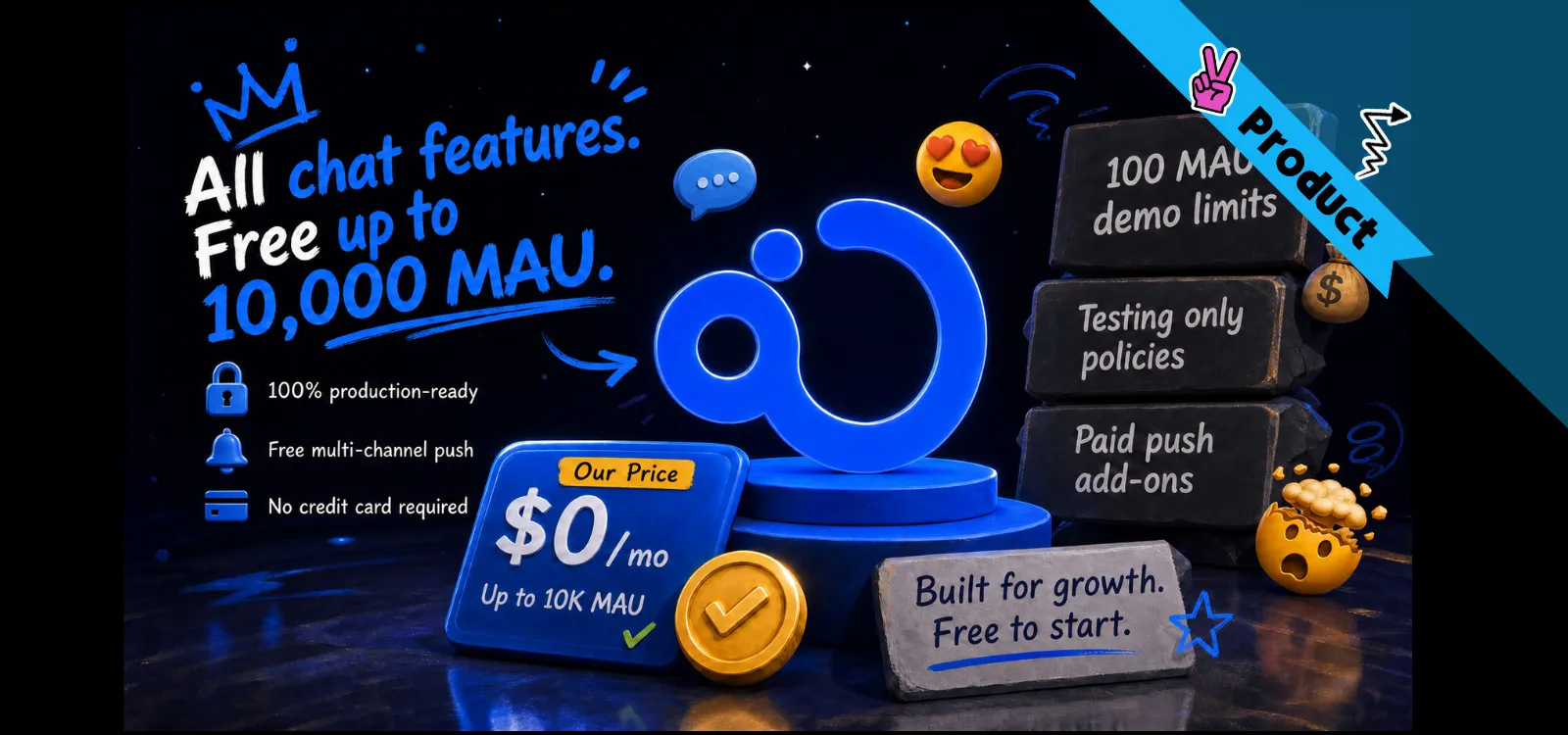
While most providers restrict their free tiers to 100–1,000 MAU with scaled-back features, Nexconn unlocks its complete Pro-tier feature set at $0for up to 10,000 MAU through the Nexconn Production-Ready Free Plan. That includes capabilities rarely seen in entry-level tiers—such as native multi-channel push, 180-day message retention, and nested Community Channels supporting sub-channels and member groups.
Here is how the top chat SDK providers stack up when you look past the headline numbers and audit the actual feature matrix.
Free Chat SDK Limits: MAU and Concurrency Compared
Dimension
Nexconn
Sendbird
CometChat
Stream
PubNub
Tencent RTC Chat
Free MAU
10,000
100 (permanent)
100
1,000 (self-serve) / 2,000 (Maker Account)
200
1,000
Concurrent connections
5% of MAU (500 at 10K)
10
25
100 (self-serve) / hard-capped
Unlimited (bounded by 200 MAU)
Unlimited (bounded by 1,000 MAU)
Monthly message volume
Unlimited
Unlimited
Unlimited
Unlimited (storage caps apply)
1M transactions (or 200 MAU cap)
Unlimited
*Sendbird's often-cited "1,000 MAU free" figure refers exclusively to a 30-day Pro Trial. Once that trial ends, the account drops to the permanent Developer plan at 100 MAU — a fact confirmed independently by multiple third-party pricing analyses.
Free Chat SDK Feature Comparison: What’s Included at $0
Vendor
Free MAU
Free Concurrent
Push Included
Feature Completeness
Realistic For
Sendbird
100 (permanent)
10
✗ Separate integration
Most Pro features with usage caps
Prototyping, internal testing
CometChat
100
25
✗ Separate integration
Core features, moderation metered
Prototyping, small internal tests
Stream
1,000 (self-serve) / 2,000 (Maker Account)
100 (hard-capped)
✗ Paid add-on
Core features included
Early prototypes; rejects excess volume
PubNub
200
Unlimited
✗ Separate integration
Core pub/sub (build-your-own chat)
Testing and development only
Tencent RTC Chat
1,000
Not capped per vendor docs
✓
Full-featured per vendor docs
✓ Yes, explicitly
Nexconn
10,000
5% of MAU (500 at 10K)
✓ Multi-channel, no extra cost
Full Pro-Tier Feature Set
✓ Real product launches
Capabilities That Don't Show Up in Most Comparisons
Community structure that actually scales. Nexconn's Community Channels are included in the free plan, supporting up to 10,000 members with sub-channel management and member group controls included. None of the other providers compared here support a nested community structure at any tier — their group architecture is flat, meaning a Discord-style hub has to be built from scratch on top of whichever SDK is chosen, rather than configured.
Broadcast that covers four distinct patterns. Reaching every user, only currently online users, a tagged segment, or every active open channel simultaneously solves four different operational problems — a platform-wide announcement, a time-sensitive promotion, a targeted campaign, a coordinated message across concurrent live rooms. Open Channels under Nexconn's offer also support priority senders and priority messages specifically, meaning time-sensitive or VIP-originated messages can be configured to route ahead of general traffic during high-volume moments — a distinction that matters for live or event-driven use cases and isn't something the other providers here expose as a configurable free-tier option.
Webhook coverage that includes pre-send events. Most vendors offer post-messaging webhooks — an event fires after a message is delivered. Nexconn's webhook set includes pre-messaging events as well, which matters for any workflow that needs to inspect, modify, or block a message before it reaches a recipient rather than reacting after the fact.
Multi-device support and live presence as standard, not an upsell. Client-side presence and multi-device session support are included in Nexconn's offer without a separate configuration step — relevant for any product where a user might reasonably be logged in on a phone and a desktop at once and expects consistent state across both.
The Hidden Costs of a Feature-Incomplete Free Chat Plan
The cost of a feature gap isn't always a dollar figure. Often it's a question a team can't answer until they've already spent engineering time finding out the hard way.
Missing or Limited Feature
What You Can't Validate
Short message retention (7 days)
Whether users return to a conversation after the first week — most of what "does this chat feature drive retention" actually means
No native friend system
Whether a social-graph-dependent flow works as designed, without building the relationship layer yourself first
No Community Channel support
Whether a nested community structure holds up at real scale — group behavior at 50 members doesn't predict behavior at 3,000
No push bundling
Whether the product feels reliable to a user whose app isn't open — arguably the most common cause of "this chat feature feels broken" in early testing
Free tier restricted to test/dev use
Whether the product works for actual users at all, since the free tier itself isn't licensed for that
Which Free Plans Can Actually Carry Production Traffic
Whether a vendor blocks you at the limit is one question. Whether the limit itself is large enough to survive contact with real users is a different one — and it's the question most comparisons skip, because it requires thinking about usage patterns, not just headline numbers.
Here's the pattern worth understanding before anything else in this section: MAU and concurrent connections aren't the same constraint, and free plans in this category are consistently generous on the number that's easy to market and tight on the number that actually determines whether a live feature holds up.
Consider a modest group chat or live-audio feature with 80 real monthly active users — comfortably inside Sendbird's, CometChat's, and PubNub's free MAU ceiling, no overage in sight. Now suppose a scheduled session or an active conversation pulls in 15% of those users at the same moment, which is an unremarkable engagement pattern for anything with a live or social component. That translates to 12 people online at the same moment. Sendbird's permanent free tier caps concurrent connections at 10 — meaning a product that hasn't exceeded its MAU limit can still hit its concurrency ceiling with a modest live session. CometChat's ceiling of 25 has room today but leaves almost nothing for a single evening peak, a launch spike, or normal week-over-week growth. None of this involved a single MAU overage. The product just did what social and live products normally do: cluster real usage around specific moments, not spread it evenly across a month.
That's the gap a pure MAU comparison hides, and it's the specific place where Nexconn's offer is built differently rather than just bigger:
Metric
Nexconn
Sendbird
CometChat
Stream
PubNub
Tencent RTC Chat
Free MAU
10,000
100
100
1,000
200
1,000
Free concurrent connections
500
10
25
100
Tied to transaction volume
Not capped per vendor docs
MAU headroom vs. Nexconn
—
100×
100×
10×
50×
10×
Concurrent headroom vs. Nexconn
—
50×
20×
5×
Not directly comparable
Not directly comparable
At every comparison point in this table, Nexconn's offer provides at minimum 5 times the concurrent-connection headroom and 10 times the MAU headroom of the second-most generous — and up to 100 times either number against the tightest free tiers in the category. That headroom is what separates a free tier that can carry a real soft launch from one that technically works in a demo and starts failing the moment actual users show up at the same time.
Who Should Choose Nexconn’s 10,000 MAU Free Plan?
Three groups tend to get the most out of this particular offer:
Teams already on another chat provider and feeling the cost or complexity. If message overage costs, push notification setup, data migration effort, or general integration complexity have become a recurring conversation on a team exploring Sendbird alternatives, evaluating CometChat replacements, or looking for Twilio Conversations alternatives, end-to-end migration support is included at no extra cost with the Nexconn offer — a factor that removes one of the biggest deterrents to switching — and the offer is worth evaluating directly against whatever's driving that friction.
Early-stage teams sizing up a real build. Startups in the 5-to-50-person range currently evaluating chat infrastructure for a social, marketplace, live-stream, or gaming product — where community structure, broadcast messaging, or relationship features are part of the roadmap rather than a maybe-later item — are close to the ideal fit for what this tier includes.
Teams running multiple projects or early proofs of concept. Developers managing several projects at once, or validating a proof of concept before committing budget, get more room to experiment at 10,000 MAU with the full feature set than the smaller ceilings most competitors offer would allow.
Ready to see what a feature-complete free plan can actually support? Start building on Nexconn — no credit card required.
We'd love to discuss how Nexconn's real-time communication solutions can support your business. Request a demo, explore pricing, or get tailored onboarding guidance.